|
PHILHARMONICA. International Music Journal
Reference:
Litvikh, E.V., Shi, J. (2026). On The Technical and Expressive Features of Chinese Cello Music, Using the Example of the Cycle "Seven Tunes Heard In China" by Sheng Zongliang (Bright Sheng). PHILHARMONICA. International Music Journal, 1, 40–57. https://doi.org/10.7256/2453-613X.2026.1.77875
On The Technical and Expressive Features of Chinese Cello Music, Using the Example of the Cycle "Seven Tunes Heard In China" by Sheng Zongliang (Bright Sheng)
Litvikh Elena Vyacheslavovna
ORCID: 0000-0002-3370-7825
PhD in Art History
Associate Professor; Department of Musical Education and Training; A.I. Herzen Russian State Pedagogical University
48 Moika River Embankment, Saint Petersburg, Russia, 191186

|
composer.elena@yandex.ru
|
|
 |
Other publications by this author
|
|
|
Shi Jiahuan
Postgraduate student; Institute of Music, Theater and Choreography; A. I. Herzen Russian State Pedagogical University
Russia, St. Petersburg, nab. Moika River, 48
|
|
2892573586@qq.com
|
|
 |
Other publications by this author
|
|
|
DOI: 10.7256/2453-613X.2026.1.77875.2
EDN:
PKRPCJ
Received:
11/01/2025
Published:
04/12/2026
Abstract: The subject of this article is the suite Seven Tunes Heard in China by Sheng Zongliang (Bright Sheng), examined in two aspects: as one of the outstanding works of contemporary Chinese composers for cello and as an example of musical multiculturalism. Particular attention is paid to the synthesis of various stylistic influences, which is manifested in all components of the musical language of the work: modal organization, rhythm, texture, timbre, and performing technique. The authors of the article analyze the methods and techniques for working with musical material borrowed by the composer from both Chinese traditional music and a number of European styles and movements. They also examine the cultural connotations of the composer's expressive means (in particular, the symbolic significance of imitating the guqin's sound and associative "references" to the music of J. S. Bach). The multicultural nature of the work under study prompted the authors to employ a comparative cultural method. A holistic analysis of the musical work was also employed. The scientific novelty of this article lies in its detailed, comprehensive analysis of various aspects of the work under study, reflecting their synthetic, multicultural nature, which manifests itself at all levels of the composition—in musical language, the structure of the cycle, and musical and aesthetic principles. The conceptual and symbolic function of Bach's stylistic features and the imitation of guqin playing in Sheng's suite are revealed; conceptual parallels are drawn between Sheng Zongliang's Seven Tunes Heard in China" and Tan Dun's Ghost Opera. The authors conclude that Seven Tunes Heard in China played a significant role in the development of Chinese cello music, as well as the mutually enriching nature of the intercultural interaction embodied in Sheng Zongliang's suite. Specifically, applying Western methods of polyphonic development to traditional Chinese melodies reveals new expressive possibilities. At the same time, the introduction of sound production techniques borrowed from traditional Chinese instruments into cello music enriches the cello's technical arsenal and timbral palette, and contributes to the rapidly expanding range of performance techniques in avant-garde music.
Keywords:
extended performance techniques, imitation of traditional instruments, musical multiculturalism, cello glissando, suite for cello, Chinese cello performance, Bright Sheng, Sheng Zongliang, erhu, guqin
Introduction. Chinese cello art is relatively young: the active introduction of the instrument into China's musical life began only in the second half of the nineteenth century. However, a long way has been traveled in this short period of time, and currently, cello performance in China is at a very high level, as evidenced, in particular, by the large number of internationally renowned performers, as well as the presence of Chinese experts on the jury of prestigious international competitions.
One of the important factors contributing to the development of cello performance in China was the creation by Chinese composers of a national repertoire that combines elements of traditional Chinese music with Western (classical and avant-garde) music. As with other Western instruments, the first works for the cello by Chinese composers were mainly treatments of traditional music, which certainly contributed to the acceptance of the new instrument by musicians and the public.
However, with the development of the level of performance and integration of China into the international cultural environment, there is a growing need for such works that would not be limited to the external features of traditional music, but, based on the inherent features of musical thinking, as well as on the achievements of Western music, would represent an organic fusion of cultural traditions. According to researchers, it is precisely such works that contribute to the preservation of Chinese music's national identity in the context of globalization [1; 2].
In this regard, the experience of Chinese avant-garde composers, including those working abroad (such as Sheng Zongliang, Tang Dong, Chen Qigang, Chen Yi, and others), seems very promising, given that the Western avant-garde as a whole is much closer to Eastern culture than Western classical music [3]. This explains the relevance of studying Sheng Zongliang’s works. In addition, the study of the composer's work is of interest not only in the context of Chinese music, as it reflects a number of current trends in modern musical art.: the tendency to synthesize various cultural traditions, the active use of borrowed material, and the significant role of performing freedom, which, on the one hand, originates from Chinese traditional music, and on the other hand reflects the current state of the composer-performer-listener communication system [4].
The work of Sheng Zongliang (Bright Sheng). Sheng Zongliang, better known by his pseudonym Bright Sheng (note 1), is a Chinese-American composer whose work is characterized by an organic synthesis of Chinese and Western musical traditions, grounded in a deep understanding of both cultures and in virtuoso compositional skills. The composer was born in 1955 in Shanghai and began studying piano at an early age. During the Cultural Revolution, Sheng was placed under a "re-education" program for urban youth and was sent to a rural area (Qinghai Province). Thanks to his piano playing skills, the young man was able to get a job at a local theater as a pianist and drummer, thus avoiding heavy agricultural work [5]. In Qinghai, Sheng became closely acquainted with the diverse local folklore, which, according to the composer, greatly influenced his work [5]. There, he also began collecting folk songs and composing music. After the end of the Cultural Revolution, Sheng entered the Shanghai Conservatory and then moved to the United States to continue his studies (at King's College and then at Columbia University), where he still lives.
B. Sheng's work is currently being actively studied by musicologists from different countries [6-12]. The main attention of researchers is attracted by the combination of elements of traditional Chinese and Western musical culture in his works, in particular, in orchestration (Lee, Hsuan-Yu. A Study on Hybrid Style and Orchestration in Bright Sheng's Postcards. Dissertation Prepared for the Degree of Doctor of Musical Arts. University of North Texas, 2015. 59 p.) [6–11]. A number of studies are devoted to the analysis of individual works of the composer and the issues of performing interpretation of his compositions [12] (Kang, Chiao-Hsuan. Understanding of Authentic Performance Practice in Bright Sheng's "Seven Tunes Heard in China" for Solo Cello. Dissertation Prepared for the Degree of Doctor of Musical Arts. Louisiana State University and Agricultural and Mechanical College, 2016. 65 p. doi: 10.31390/gradschool_dissertations.1639; 曹筱勤.华人作曲家盛宗亮三部钢琴组曲音乐研究//华中师范大学,2022, 66页。DOI:10.27159/d.cnki.ghzsu.2022.001906 / Cao Xiaoqin. A study of three piano suites by the Chinese-born composer Sheng Zongliang: Master's degree. diss. Central pedagogical University Huajun, 2022. 66 p.; 张远佳.盛宗亮大提琴无伴奏曲《七首中国曲调》的音乐特征与表演实践.2024.上海师范大学MA thesis. doi:10.27312/d.cnki.gshsu.2024.002431 / Zhang Yuanjia. Musical features and performance practice of Sheng Zongliang's unaccompanied cello pieces "Seven Tunes Heard in China": Master's degree. diss. Shanghai normal University, 2024. 42 p.; 舒海艺.盛宗亮钢琴组曲《花儿拾零》的民族特色及演奏分析//.浙江师范大学,2023, 40页。DOI:10.27464/d.cnki.gzsfu.2023.000703 / Shu Haya. National peculiarities and performance analysis of Sheng Zhongliang's piano suite "Collected Flowers" (Hua'er Shiling): Master's degree. diss. Zhejiang Pedagogical University, 2023. 40 p.).
The purpose of this article is to analyze Bright Sheng's suite Seven Tunes Heard in China ("Seven Melodies Heard in China") for solo cello from two different sides: as a work that opened up new perspectives for the development of Chinese cello music and as a composition that represents an example of currently relevant musical multiculturalism.
Seven Tunes Heard in China: an analysis of the elements of musical language and the artistic concept of the cycle. The suite "Seven Melodies Heard in China" for solo cello was written in 1995 for the outstanding Chinese-American cellist Yo-Yo Ma and was first performed by him (in his own edition) that same year. Some researchers consider this work to be a "harbinger" of the Silk Road project, created by Yo-Yo Ma in 1998 (note 2). In particular, Zhang Baojun points out that the creation of Seven Tunes Heard in China coincided with the period of preparation for the Silk Road project and can therefore be considered in this cultural context [8]. Seven Tunes Heard in China has gained wide recognition worldwide and, according to Zhang Baojun, can be called the quintessence of late-20th-century Chinese cello music [8]. Based on authentic Chinese melodies, the composer significantly reinterprets them, thereby making them an element of multicultural stylistic synthesis.
According to the composer's own words, Bartok's work had a significant influence on him, especially his approach to working with folk material. Thus, Sheng noted that Hungarian folklore became known worldwide thanks to Bartok's efforts, and that modern Chinese composers, through their musical works, also enable the world to understand China's cultural traditions and historical heritage [14].
Genre. The structure of the cycle. The composer used seven melodies as musical material in Seven Tunes Heard in China: "Seasons", "Guessing Song", "Little Cabbage", "The Drunken Fisherman", "Du Du Dong", "Pastoral Ballade", and "Tibetan Dance".
One of the main distinguishing features of the work is that authentic Chinese melodies are written within the framework of the classical Western genre (instrumental suite), and the composer gives a "reference" to a specific sample of this genre – the famous suites for solo cello by J. S. Bach. This is felt, in particular, in the very significant role of imitation polyphony techniques, as well as in the number of parts: five of the six Bach cello suites contain exactly seven parts. However, apart from the fact that most of Sheng's work is based on melodies of a song rather than a dance type, the structure of the Chinese composer's cycle also differs from Bach's: if each suite opens with a prelude, then the tempo sequence in Sheng's work rather corresponds to a suite that begins directly with an allemande (without an introductory piece): Moderato; Allegro; Adagio; Adagio–Moderato; Allegretto; Lento–Adagio; Allegro. Thus, the tempo sequence of the parts in Seven Tunes Heard in China corresponds to the typical structure of the German "version" of the ancient suite, based on 4 obligatory dances: allemande (moderate), courante (fast), sarabande (slow) and gigue (very fast) [15] with the possibility of including additional pieces between the last two required ones. At the same time, the thematic contrast between the parts of Sheng's cycle is much stronger than in the old suite, since melodies belonging to different local traditions are used (Table 1).
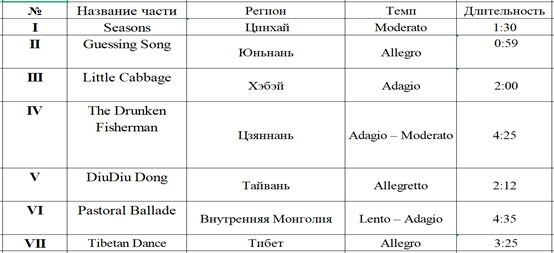
Table 1. B. Sheng. Seven Tunes Heard in China. The scheme of the structure of the cycle.
According to the researchers, some stylistic "diversity" in the construction of the cycle corresponds to Chinese aesthetics, since in such a "scattered" form the integrity of the spirit is revealed [6; 8] (note 3). At the same time, the composer does not limit himself to comparing and contrasting pieces, but combines the cycle using a number of special techniques. So, in some cases, the last note of the previous movement (or one of the sounds of the final chord) becomes the first note of the next one.: This is how parts one and two, four and five, as well as parts five and six, are connected. In addition, there is a thematic connection between parts II and III: at the end of the "Guessing Song", the beginning of the melody "Little Cabbage" is introduced in advance, forming an entertaining dialogue (examples 1 and 2).
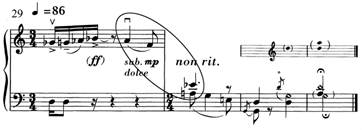
Fig. 1. B. Sheng. Seven Tunes Heard in China. Guessing Song. Bars 29–31.
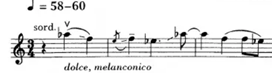
Fig. 2. B. Sheng. Seven Tunes Heard in China. Little Cabbage. Bars 1–3.
In addition, the composer’s timbre highlights the central part of the cycle, which is performed pizzicato throughout. All these techniques help to combine seven initially unrelated melodies into a single whole. Thus, it can be said that, in constructing the cycle, the composer combines elements of Chinese aesthetics (according to which the whole can consist of a juxtaposition of disparate fragments) and Western European aesthetics (which values structural order, logical consistency, and the relationship between the previous and the subsequent).
Lad. Intervals. Seven Tunes Heard in China features an original combination of pentatonic and dissonant chromatics. This combination of folk modes and acute dissonant harmonies undoubtedly goes back to Bartokov's method of working with musical folklore [16]. However, if Bartok's harmony is still based on the major-minor harmonic system, although significantly expanded and complicated, but based on the classical ratio of chords and functions, then another principle is noticeable in the Sheng suite: the basic unit of the harmonic system is the interval, not the chord.
This principle is more typical of the Austronesian branch of European music of the 20th century, although its origins can be found a little earlier. Thus, even in the later works of J. Brahms, there is a noticeable tendency to endow the interval, rather than the chord, with the function of the main "building element" of the harmonic system [17]. V. N. Kholopova and Yu.N. Kholopov draw attention to the predilection for certain intervals and combinations of intervals in A. Webern's serial music, considering this feature of the high-pitch system as an effective means of harmonic structuring in the context of twelve-tone chromatics, which has already lost its connection with the major-minor system [18].
The principle of constructing consonances from a limited number of repeated intervals is also noticeable in the Sheng suite. Three-tone chords are usually combinations of fifth+septima or fourth + septima. There are also combinations of two fifths, which is obviously related to the design of the instrument. An analysis of the intervals sounding in the work allows us to conclude that the composer mainly uses fifths as consonances (a typical example is the doubling of the melody into a fifth in the reprise of the Fifth movement of the suite) and, sometimes, quartos. Thirds and sexts are used much less frequently and, most importantly, they usually appear either as productive verticals in the zones of bourdon two–voice (when the sound of an open string is repeated in the lower voice), or as consonances of quasi-heterophonic two-voice (note 4), and as such they do not have significant functional differences from seconds, quarts, or septim and do not perform the functions of a consonant stand (Example 3).

Fig. 3.
Fig. 3. Bright Sheng. Seven Tunes Heard in China. Tibetan Dance. Bars 152–156.
Thus, the overall harmonic flavor of the suite is determined by a combination of archaic-sounding perfect consonances and modern dissonant harmonies, which emphasizes the work's stylistic diversity.
Rhythm. Chinese traditional music, in general, is characterized by metrorhythmic freedom. For example, since the Tang era (618–907), Chinese music has used the free "sanban" metrorhythm (サ is indicated in the notes), the degree of variation of which exceeds that of Western rubato. This meter emphasizes the leading role of the performer, who follows his own understanding of the work solely.
Such a strong variability of the metrorhythm, depending on the performance interpretation, is not typical for Western classical music, but it has become widespread since the 2nd half of the 20th century due to the general tendency to move away from a strictly fixed text and leave a number of composition parameters at the discretion of the performer, which significantly modifies the functions of participants in the communicative triangle "composer – performer – the listener" [4]. Thus, metrorhythmic freedom can be considered one of the points of contact between Chinese traditional music and the Western avant-garde, and this quality is widely used by modern Chinese composers.
In Seven Tunes Heard in China, most parts have a precisely fixed rhythm; however, fragments of part IV, recorded without clock features, clearly indicate a free manner of performance (example 4).
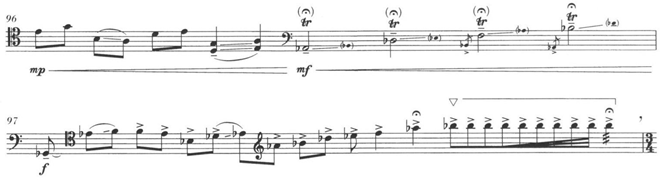
Fig. 4. B.
Fig. 4. B. Sheng. Seven Tunes Heard in China. Part IV: The Drunken Fisherman. Bars 96–97.
In addition, the rhythmic recording of the song "Little Cabbage" in Part III speaks to the composer's desire to reflect, with the help of precisely recorded durations, the metrorhythmic freedom and variability of the folk manner of performance. This becomes obvious if we compare the recording of this song in Tang Dong's Gost Opera and Sheng Zongliang's Seven Tunes Heard in China. In the first version, the song is recorded in a regular size, with phrases of the same length (1 bar), each beginning on the first beat, and there is clearly a rhythmic similarity between them. In the second variant, the lengths of phrases and the ratios of their durations vary, and the beginnings of phrases fall at different time bars (examples 5 and 6).
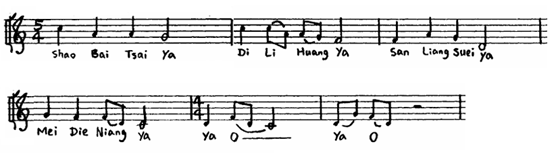
Fig. 5. Tang Dong. Ghost Opera. Part I.

Fig. 6. B. Sh
Fig. 6. B. Sheng. Seven Tunes Heard in China. Little Cabbage. Bars 1–8.
In addition, the second holding of the melody in Sheng's composition is rhythmically different from the first. All this creates a sense of rhythmic flexibility and improvisational freedom of performance. In the sixth part of the cycle (Pastoral Ballade), the composer uses constant tempo variation, which, along with the detailed recording of durations, also creates the effect of improvisational freedom of rhythm.
At the same time, at the end of the cycle, the composer uses special means of dynamizing the metrorhythm. Although metric variability is found in Tibetan dances, such frequent changes in size, as in the Tibetan Sheng Dance, are not typical of traditional music. In this case, we can talk about the composer's creative reworking of Tibetan dance music, which enhances the energy of the metrorhythm by constantly changing its size. This technique, apparently, dates back to the works of neo-folk composers (primarily B. Bartok and I. F. Stravinsky). In addition, metrorhythmic irregularity is also created by a dialogue of different timbres – tapping on the body of the instrument and playing with a bow, and the "replicas" of this dialogue have different lengths that do not coincide with the length of the bars (example 7).

Fig. 7. B.
Fig. 7. B. Sheng. Seven Tunes Heard in China. Tibetan Dance. Bars 22–27.
It is also significant that the rhythmically free parts of the suite are interspersed with pieces of the motor warehouse, which generally contributes to the dynamism of the form.
The invoice. Despite the fact that the cello is primarily a melodic instrument and the material of the piece consists of single–voice melodies, in none of the parts of the suite is the composer limited to a single melodic line. He uses quasi-accompaniment (pizzicato with the left hand in the V movement), imitation of the dialogue of two instruments with different timbres (a combination of tapping on the body of the instrument and playing with a bow in the finale of the cycle), chord texture (it is most widely used in the IV movement), bourdon two- and three-voice, the effect of heterophonic two-voice (see example 3). However, most often the composer turns to imitative two-voice. In this case, both extended phrases and very short fragments of the melody can be imitated. For example, the dialogue of various variants of such short motifs isolated from the theme is an important factor in the dynamization of the musical process in the Fifth movement of the suite (example 8).

Fig. 8. B. Sheng. Seven Tunes Heard in China. Diu Diu Dong. Bars 54–60.
Such a well-developed polyphonic technique is not typical of Chinese traditional music, which is linear in nature. However, by combining Chinese melodies with the achievements of Western polyphonic technology, the composer opens up new opportunities for the development of the traditional musical art of his country at the present stage.
Performing technique. Seven Tunes Heard in China also features an extraordinary variety of playing techniques. The composer outlined in detail in the score various ways of producing sound, most of which refer to the techniques of traditional Chinese instruments. Such imitation techniques are often used in Chinese music for any Western instrument. However, in the works for cello, they sound, perhaps, especially organically, since this instrument is close to erch in its design and timbre, and besides, the sonorous cello pizzicato also allows you to imitate plucked instruments. In "Seven Melodies Heard in China", the use of such techniques is characterized by great variety and ingenuity, which, on the one hand, is an important contribution of Sheng to the development of Chinese cello art, and on the other hand, fits into one of the leading trends in avant-garde music: the expansion of performing techniques [19; 20].
More often than others, glissando and pizzicato techniques are used in the work. Glissando occupies an important place in the performance of Chinese folk instruments, being one of the main techniques of playing stringed bows – for example, erhu [Liu Huijuan, S. V. Anikienko] (2015. MA thesis / Tian Ye. The study of glissando technique on the erhu: Master's degree. diss. Tianjin Conservatory of Music, 2015. 20 p.). Therefore, in the works of Chinese composers, this technique is often used to evoke the sound of traditional instruments [3; 12].
Seven Tunes Heard in China uses three types of glissando:
① "Immediate" glissando : gliding is present throughout the duration of the first note, emphasizing the transition between sounds.
② "Finishing" glissando : The glide begins at the end of the duration of the first note. This technique enriches the melody with additional intonational nuances.
③ The "return" glissando (Huihuayin, Huihuayin). This type of sliding is not indicated by a special sign in the score, but given the characteristic melodic turns and practice of playing on Chinese traditional instruments, it can be assumed that its use is implied. The return glissando is used not only on Chinese bowed instruments such as the erhu but also on plucked instruments such as the zheng, qin, pipa, and others. Its key feature is that the left-hand finger, indicating the pitch of the main sound, slides to the neighboring sound (usually a second or a small third up / down), then quickly returns to the original one. The listed glissando techniques are present in all seven parts of the cycle (example 9) and are even used actively in the fourth part, which is entirely performed pizzicato.
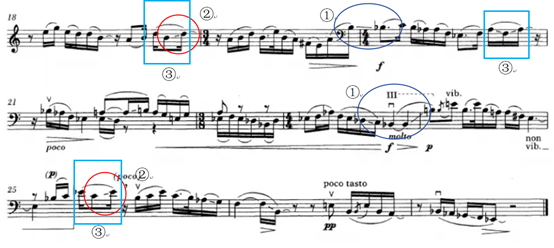
Fig. 9. B. Sheng. Seven Tunes Heard in China. Part I: Seasons. Bars 18–27.
The composer suggests an original timbre solution in the fourth part of the cycle, based on the play for Qin (note 5) "The Drunken Fisherman" ("The Drunken Fisherman's Evening Song"). This part of the cycle is performed entirely by pizzicato, and for some sounds a pick is used, which makes the sound more sonorous and brings it closer to the timbre of the qin, which performers use their nails when plucking the strings of the instrument. In addition, as N. A. Feofanova points out, combinations of regular pizzicato and pizzicato using a pick can simulate playing the guitar with different fingers, which differ significantly in strength [12]. The piece also makes extensive use of the characteristic technique of playing the qin, glissando, in which only the first sound is extracted by plucking, and the second (and with the return glissando also the third). It is achieved by sliding a finger along the string without pinching; in this case, the sound naturally fades (example 10).
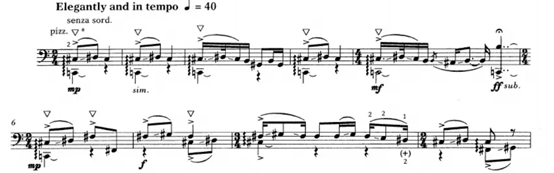
Fig. 10. Bright Sheng. Seven Tunes Heard in China. Part IV: The Drunken Fisherman. Bars 1–9.
In addition, pizzicato is used in the piece with flageolets, which the composer prescribes to be performed with a fingernail and close to the stand, which makes them ring and brings them closer to the timbre of the qin (example 11).
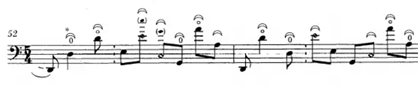
idea of the unity of heaven and man. From an aesthetic point of view, the sound of the qin is associated with qualities such as refinement, elegance, sublimity, nobility, and restraint.
Probably, by placing a piece imitating the sound of such a symbolic instrument in the center of the composition, the composer seeks to emphasize his continuity with traditional Chinese culture. At the same time, there is also an obvious desire to fit this musical tradition into a global context, which is expressed in the assimilation of various Western influences and, in particular, in associative links (thanks to the genre and the widespread use of imitative polyphony) with the work of J. S. Bach—one of the pillars of European musical culture. Bach's music, saturated with a variety of symbols, eventually came to be perceived as a symbol of high spirituality, aesthetic perfection, and music itself [25]. Therefore, many composers of the twentieth and twenty-first centuries appeal to it in one way or another (D. D. Shostakovich, I. F. Stravinsky, A. G. Schnittke, L. Berio, V. Rome, etc.). As for Chinese composers, it is noteworthy that in Tang Tung's Ghost Opera (1994), created shortly before Seven Tunes Heard in China, there is a quote from CTC (prelude to cis-moll II volume), which, apparently, should represent the shadow ("ghost") of the author (judging by the fact that Bach is included by Tang Tong in the "cast of performers" of Ghost Opera).
There is no such personification in Seven Tunes Heard in China. However, Bach's music seems to be perceived by Sheng as a symbol of European culture and of Qing–Chinese performance. The combination of these symbols with Chinese national melodies and their development methods, applied to a wide range of European music phenomena, creates a stylistic fusion reflecting the cultural diversity of the modern world.
Thus, the multicultural synthesis in Seven Tunes Heard in China manifests itself both at the level of musical language elements and at the level of musical symbolism and the general concept of the cycle. This desire to combine elements of different cultures into a synthetic whole, in which the characteristic features of each of them clearly appear, reflects the aesthetic position shared by many Chinese composers of the 20th century, especially those working abroad. Thus, Columbia University professor Zhou Wenzhong, who studied with Sheng Zongliang, Tang Dong, Chen Yi, and many other Chinese composers, noted: "Let's not talk about influence, but about merging. Let different traditions intertwine, creating a new mainstream that will combine all musical concepts and practices into a vast space of musical trends. But we must also ensure that each culture retains its uniqueness, its poetry" [11, p. 179].
In his own words, Sheng Zongliang did not intentionally seek to create a "Chinese style." His goal was to develop his own musical language reflecting his multidimensional vision of the world as a representative of different cultural traditions (Chinese and Euro-American). "All my life, I have sought to deepen my understanding of Western and Asian cultures, hoping that my works reflect my personal desire for an evolving musical style that can express my thoughts while preserving the unique cultural characteristics inherent in each work," the composer noted [26].
Seven Tunes Heard in China had a significant influence on subsequent works by Chinese composers for cello. Thus, the development of the idea of imitating national instruments can be found in Chen Yi's work "Qin, Xiao, Bell, Drum and Sheng" (1998) for cello and orchestra, and the idea of turning to the Baroque genre in Chiacone, after Colombi, for solo cello by Tang Dong (2010).
Conclusions. The conducted research allows us to come to the following conclusions:
1. Seven Tunes Heard in China by Sheng Zongliang (B. Sheng) is an important milestone in the development of Chinese cello music, as it accumulates many stylistic features characteristic of instrumental music of the 20th century in China, and also opens the way for further creative research in this field.
2. Seven Tunes Heard in China is a vivid example of modern musical multiculturalism: the fusion of various stylistic influences is noticeable in all aspects of the work: fret organization, rhythm, texture, timbre, cycle structure, aesthetics, and musical symbolism. At the same time, the Sheng Suite is an example of the mutual enrichment of cultures: for example, the use of Western techniques of working with musical material opens up new opportunities for the development of traditional Chinese musical art, while borrowing melodic material, some principles of musical thinking, performing techniques and timbre effects from Chinese traditional music enriches the arsenal of expressive means of the Western avant-garde.
3. Seven Tunes Heard in China can rightfully be considered an outstanding work that has enriched not only the Chinese but also the world concert repertoire for cello.
1. The pseudonym Bright Sheng was chosen by the composer himself and formed by translating into English part of his Chinese name (亮 – Liang – bright, bright) while retaining the Chinese surname [5].
2. The Silk Road Project was founded by Yo-Yo Ma in 1998 with the aim of combining the creative efforts of artists from different countries, including those historically associated with the famous trade route. Over the years of the project's existence, dozens of musicians (composers, performers, arrangers), artists, and scientists from Europe, Asia, and North America have participated in it [13].
3. The unity of the spirit with the apparent fragmentation of form – 形散神聚" (xíng sàn shén jù) is one of the key principles of classical Chinese aesthetics, describing a creative concept in which the externally free, flexible structure of form serves to reveal and emphasize the inner, higher unity of spiritual content. This idea is deeply rooted in traditional Chinese philosophy and worldview. Thus, Taoists believe that the primary source of the universe, the Tao, is one and integral. It generates myriads of things that have different forms ("disparity of form"), but all are permeated and connected by a single "Tao" or "Qi" ("unity of spirit"). This means that, having comprehended the spiritual content, one can go beyond the external form ("yang"). This directly inspired in art the desire for spirituality, surpassing attachment to external resemblance to certain objects of reality. In Zen Buddhism, it is believed that the truth is integral, but the ways of expressing it can be fragmentary and suggestive. In Chinese landscape painting, this aesthetic principle is reflected in the "diffused perspective": unlike Western linear perspective, each area of the image has its own center, and the viewer can mentally "move" through the painting, examining it fragment by fragment. At the same time, the whole landscape is united by a single mood, forming a holistic world in which you can mentally live and "travel".
4. Technically, this two-voice is performed in the same way: with the help of a repeating sound of one of the open strings (except the lower one) and an overlapping melody played on another string. However, due to the lack of register distance, the repetitive sound is not heard as a separate, independent voice, creating the effect of heterophony.
5. This instrument is now often referred to as the guqin. The word "gu" in the name of the instrument means "ancient"[22].
6. The richness of the overtone spectrum is an important factor that brings the cello and the qin closer together: as Wang Ying points out, the qin is one of the most overtone—rich musical instruments [22].
7. As N. A. Feofanova points out, the performance of some techniques imitating the sound of the qin on the cello (in particular, the nail pizzicato with flageolets and a tremolo pick) is fraught with great difficulties [12]. However, this is justified by an artistic task.
8. According to the ideas of Confucian thinkers, the policies of the three great dynasties (meaning the Xia dynasty (2224–1766 BC), the Shang Dynasty (1766–1122 BC), and the Zhou Dynasty (1122–256 BC)) were an example of an ideal social and state system [24].
9. As Gong Zihui points out, the tradition of playing the guqin of Taoist hermits is a separate trend in the art of performing on this instrument [23].
The article is published in the version approved by the reviewers (after receiving a positive review recommending the manuscript for publication) with corrections made by the author (after receiving the editor’s comments, if any).
Read all reviews on this article
References
1. Liu, J. (2022). Cultural recording of modern professional music in the intercultural context. Journal of Renmin University of China, 36(02), 188-194. https://doi.org/CNKI:SUN:ZRDX.0.2022-02-016
2. Hu, C. (2024). Integration and innovation of elements of national music in the context of globalization. Chinese Academy of Social Sciences – Chinese Academy of Social Sciences Newspaper. Retrieved from https://www.cssn.cn/skgz/bwyc/202408/t20240813_5771676.shtml-utm_source=chatgpt.com
3. Litvikh, E.V., Liu, Y. (2024). The interaction of traditional Chinese and Western musical instruments in Tang Dong's work as a multicultural dialogue. Culture and Art, 9, 41-56. https://doi.org/10.7256/2454-0625.2024.9.71670
4. Litvikh, E. V. (2021). The communicative system "composer-performer-listener" in the context of modern musical culture. Naukosfera, 10-2, 15-20. https://doi.org/10.5281/zenodo.5606589
5. Bright Sheng. (n.d.). An interview with Bright Sheng. Retrieved from https://quod.lib.umich.edu/j/jii/4750978.0007.103/--interview-with-bright-sheng-rgn=main;view=fulltext
6. Svid, M., & Shi, Z. (2009). Leading trends of East and West music-the contribution of Tan Dun and Sheng Zhongliang to world music. Sea of Arts, 36-37.
7. Sun, X. (2024). "Northern songs and southern songs: a lament-overview of the creative concepts of Sheng Zhongliang and "Nanjing, oh, Nanjing!" Music Life, 1, 4-12.
8. Zhang, B. (2020). Analysis of national elements in Sheng Zhongliang's cello work "Seven Chinese Melodies" in the context of interculturality. Studies in Musical Culture, 87-99.
9. Yu, Y. (2022). A study of mixed Chinese-Western orchestration in Sheng Zhongliang's chamber music: examples from "The Stream Flows" and "The Singing Sands of the Great Gobi." Chinese Music, 1, 132-138. https://doi.org/10.13812/j.cnki.cn11-1379/j.2022.01.017
10. Chang, P. M. (2007). Bright Sheng's music: An expression of cross-cultural experience illustrated through the motivic, contrapuntal and tonal treatment of the Chinese folk song "The Stream Flows." Contemporary Music Review, 26(5-6), 619-633.
11. Zhang, J. (2023). Creating a Honglou Meng for twenty-first-century San Francisco: Musical confluence in Bright Sheng's opera, Dream of the Red Chamber (2016–2022). CHINOPERL: Journal of Chinese Oral and Performing Literature, 42(2), 165-191. https://doi.org/10.1353/cop.2023.a910841
12. Feofanova, N. A. (2019). On certain features of the interpretation of the cycle "Seven Melodies Heard in China" by Bright Sheng. Musical Journal of the European North, 3, 25-39. https://doi.org/10.61908/2413-0486.2019.19.3.25-39
13. Li, Y. (2024). "Interpretation of a new sound of world music: the example of intercultural premiere performances by the "Silk Road" Ensemble of Yo-Yo Ma." Modern Music, 1, 189-191. https://doi.org/CNKI:SUN:DDMU.0.2024-01-061
14. Wong, H.-Y. (2007). Bartók's influence on Chinese new music in the post-Cultural Revolution era. Studia Musicologica, 48(1/2), 237-243.
15. Ilyechko, M. P. (2014). Piano suite as a genre and stylistic phenomenon: main trends of evolution. Actual Problems of Humanitarian and Natural Sciences, 7-2, 133-137.
16. Sigitov, S. M. (1972). The modal system of Béla Bartók's late creative period. Problems of Modes, 252-287.
17. Litvikh, E.V. (2021). Intermezzo by I. Brahms Op. 119 No. 3: Non-classical tendencies in the music of Late Romanticism. Philosophy and Culture, 12, 33-45. https://doi.org/10.7256/2454-0757.2021.12.37234
18. Kholopova, V. N., & Kholopov, Y. N. (1984). Anton Webern: Life and creativity. Soviet Composer.
19. Khrust, N. Y. (2016). New performance techniques: An experience of classification. Scientific Bulletin of the Moscow Conservatory, 1, 124-143.
20. Davidenkova-Khmara, E. Sh. (2024). Extended instrumental techniques in modern performance practice and their timbral embodiment: an experience of classification. Proceedings of the XXXVI Session of the Russian Acoustic Society.
21. Liu, H., & Anikienko, S. V. (2022). The classical European violin and the Chinese folk instrument erhu as representatives of string instruments of the East and West. Cultural Life of Southern Russia, 4, 14-19. https://doi.org/10.24412/2070-075X-2022-4-14-19
22. Wang, Y. (2008). The embodiment of the characteristics of playing national wind instruments in Chinese piano music. News of the A. I. Herzen State Pedagogical University, 82-1, 111-120.
23. Gong, Z. (2018). The flourishing of the guqin playing tradition in China during the Song dynasty. Studies of Young Musicologists, 4, 222-238.
24. Gong, Z. (2018). Guqin in the artistic culture of ancient China: On the issue of study. Bulletin of the Institute of World Civilizations, 1, 82-85.
25. Bochkova, T. R. (2014). The phenomenon of Bachianism in musical culture. Actual Problems of Higher Musical Education, 2, 19-21.
26. Bright Sheng. (n.d.). Composer, conductor and pianist. Retrieved from https://brightsheng.com/bio.html
Peer Review
Peer reviewers' evaluations remain confidential and are not disclosed to the public. Only external reviews, authorized for publication by the article's author(s), are made public. Typically, these final reviews are conducted after the manuscript's revision. Adhering to our double-blind review policy, the reviewer's identity is kept confidential.
The list of publisher reviewers can be found here.
The relevance of the topic is determined by the need to study the processes of cultural synthesis in modern musical art. The work of expatriate composers, including Sheng Zongliang, is of particular interest in the context of the dialogue between Eastern and Western musical traditions. The analysis of the specifics of the translation of Chinese folklore material by means of modern musical language meets the needs of modern musicology in research on the problems of multiculturalism and the transformation of national traditions in the context of globalization. The subject of the research is the cycle "Seven Tunes Heard in China" for solo cello by Sheng Zongliang, considered as a representative example of the synthesis of Chinese traditional music and Western European compositional technique. Special attention is paid to the peculiarities of musical language, composition techniques and performing techniques. The methodological basis is an integrated approach that includes comparative analysis, a structural and functional method, and elements of a cultural approach. The research is based on a detailed analysis of the musical text using a wide range of contexts, from traditional Chinese music to the work of avant–garde composers of the 20th century. Methodological rigor is promoted by a systematic consideration of various parameters of the musical fabric – from the macro level (cycle structure) to the micro level (fret and rhythmic features, specific sound production techniques). The scientific novelty of the work lies in the multidimensional analysis of one of the key works of modern Chinese cello music, which has so far been insufficiently studied in Russian musicology. For the first time in the scientific literature, the following are studied in such detail: · the specifics of the synthesis of the principles of the Baroque suite and Chinese traditional aesthetics; · the technique of timbre imitation of Chinese folk instruments on the cello; · the features of the metrorhythmic organization reproducing the freedom of Chinese traditional music in terms of fixed notation. The article is characterized by a logical structure and sequence of presentation. Theoretical analysis is combined with practical observations on the musical text, which is supported by numerous musical examples. The presentation style meets academic standards, and the terminology is used correctly. Meaningful completeness is facilitated by considering both the musical parameters themselves (fret, rhythm, texture) and cultural and symbolic aspects (qin as a cultural symbol, references to Bach). The thesis about the greater proximity of Eastern culture to the Western avant-garde, which requires a more detailed justification, can be considered a debatable point. The list of references is representative and includes both fundamental works on music theory and modern research in Russian, Chinese and English. Dissertations and articles in peer-reviewed journals are widely used, which indicates that the author is well aware of the current state of the problem. All sources are correctly quoted in the text. The author takes into account possible counterarguments regarding the eclecticism of Sheng Zongliang's style, consistently demonstrating the organic synthesis of various traditions. It is indicative of the appeal to the philosophical and aesthetic concept of "unity of spirit with apparent fragmentation of form," which makes it possible to interpret the structural features of the cycle not as a disadvantage, but as a conscious artistic device rooted in the Chinese cultural tradition. The conclusions of the article follow logically from the analysis and adequately reflect the content of the work. They emphasize the importance of the Sheng Zongliang cycle for the development of both Chinese cello music and the modern multicultural musical space in general. The article is of considerable interest to musicologists, cultural scientists, cello players, as well as to anyone interested in the problems of intercultural interaction in contemporary art. The article "On the question of the technical and expressive features of Chinese cello music using the example of the Seven Tunes series Heard in China by Sheng Zongliang (Bright Sheng)" is a meaningful and methodologically verified study. The work makes a significant contribution to the study of modern Chinese music and cultural synthesis practices. Meeting all the criteria for scientific publication, the article is recommended for publication in the journal Culture and Art.
|





 © 1998 – 2026 Nota Bene. Publishing Technologies. NB-Media Ltd.


