|
PHILHARMONICA. International Music Journal
Reference:
Dzlieva, D.M. (2025). Religious-mythological songs in honor of Falar in Ossetian tradition. PHILHARMONICA. International Music Journal, 4, 1–13. https://doi.org/10.7256/2453-613X.2025.4.76309
Religious-mythological songs in honor of Falar in Ossetian tradition
Dzlieva Dzerassa Mairamovna
ORCID: 0009-0006-5295-4983
PhD in Art History
Senior Researcher; SOIGSI VNTS RAS
Honored Worker of Culture of the Republic of North Ossetia-Alania
Member of the Union of Composers of the Russian Federation
Magkaev str., 12/4, sq. 40, Vladikavkaz, Republic of North Ossetia-Alania, 362044, Russia

|
gegusa@gmail.com
|
|
 |
Other publications by this author
|
|
|
DOI: 10.7256/2453-613X.2025.4.76309
EDN:
QYLGLN
Received:
10/17/2025
Published:
01/13/2026
Abstract: The article discusses the issues of functioning, as well as samples of texts and melodies of religious-mythological songs dedicated to a representative of the Ossetian pantheon – the patron of sheep and small cattle – Falvar. The sources for this research include archival records and field materials collected by the author in 2025 in the territory of North Ossetia. The main body of materials is concentrated in the Scientific Archive of the North Ossetian Institute of Humanities and Social Research named after V. I. Abaev. The analysis also includes transcriptions of archival audio recordings stored in the phonogram archive of the Institute of Russian Literature (Pushkin House), copied in 2012 for the multimedia system "Musical Culture of the Ossetians," created within the framework of the Russian presidential grant "Origins of Culture – Preservation of Civilization." The approach to solving problems of musical-typological study of the religious-mythological song Falvaraiyza Zarga is related to the application of methods developed in the works of Russian researchers in the field of ethno-musicology. The comprehensive involvement of data from ethnography, philology, folklore studies, and ethnolinguistics ensured the study of the cult in a historical and ethnographic perspective. The relevance of the research is emphasized by the absence of specific scientific studies in this area of musical folklore. All transcriptions of the samples were made by the author of this work and are being introduced into scientific circulation for the first time. The goal of the work is to identify the musical and poetic features of the song Falvaraiyza Zarga. As a result of the research, it was found that the studied melodies are characterized by a texture typical of the folk song polyphony of the Ossetians. The overall logic of tonality in the melodies is associated with the alternation of two tonal functions: primary and secondary. In addition, songs of this genre are characterized by a stable musical-rhythmic structure of cadences in each line of verse. The socio-cultural significance of the research is underscored by the almost complete disappearance of the cult of the patron of domestic animals, which has led to the threat of a complete loss of the layer of religious-mythological songs associated with it.
Keywords:
Ossetian songs, Ossetian musical folklore, Ossetian ethnomusicology, folk beliefs, traditional culture, folk songs, religious-mythological songs, Ossetian culture, Republic of North Ossetia-Alania, Ossetians
This article is automatically translated.
Religious and mythological rituals occupy a central place in the system of rituals of the Ossetian calendar cycle. However, today it is the least preserved and sought-after religious complex. In the Ossetian national calendar, there was a holiday in honor of the patron saint of sheep and small livestock, Falvar. The subject of the research in this article is the peculiarities of functioning, as well as the typological features of songs in honor of Falvar, considered in the dynamics of historical development – from early archival recordings to modern field materials. The research was based on the structural and functional method, in which the object was divided into parts, followed by an analysis of their interrelationships. The comprehensive use of ethnographic, philological, folkloristic, and ethnolinguistic data has provided a study of this cult from a historical and ethnographic perspective. Despite the significant contribution of scientists from various fields to the study of the Ossetian religious and mythological tradition, science has so far lacked a holistic analysis of the cult in its syncretic unity: word, action, song. The lack of specialized ethnomusicological works based on an integrated approach necessitated the present study, the novelty of which lies in identifying a corpus of samples of religious and mythological songs in honor of Falvar, as well as its musical, stylistic and poetic features. The cult of Falvar is almost completely lost in the traditional rituals of the Ossetians. The only exceptions are some villages in western Ossetia and the Darchiev family holiday, timed to coincide with Falvar Day and celebrated annually in the ancestral village of Lisri. According to scientists such as V. F. Miller [1, 243-244], V. I. Abaev [2, 442] and many others, Falvara is the patron saint of small cattle, whose theonym comes from Flora and Laurel. As K. K. Kochiev points out: "The general picture that has emerged as a result of the work of several generations of Ossetian scholars is as follows: Falvara is a cattle–breeding deity who goes back to the pagan prototype, but has undergone a superficial Christianization. Due to the leading role of cattle breeding among Iranian (including Sarmatian) tribes and the presence of a developed cattle cult among them, the cult of Falvara can be considered to be descended from these cults, given that the acclimatization of the Scytho-Sarmatian cattle cult in the Caucasus was facilitated by the presence of similar beliefs among the tribes of the Kobani culture" [3, 156]. An interesting study of the cult of Falvar and its transformation from patron of sheep to patron of all livestock is found in A. V. Darchiev, who concludes that this trend spread during the 20th century [4. 38]. According to the bearers of the tradition, the holiday in honor of Falvar existed everywhere, local differences consisted in mass (by the whole village) or individual (by each family separately) celebration, as well as in the time of celebration (once a year, in summer or winter) [Note by D. Dzlieva, 10/11/2025 in Vladikavkaz from Tamaev T. A. 04/13/1950, born in Kumbult], or twice a year in spring and autumn [5, 198]. According to ethnographic literature, as well as modern field materials, dzikka (porridge made of cheese and flour) was cooked in the house especially for the holiday and an animal was sacrificed. Both in the past and in the present, it was a ram, certainly one of those that were born this year [6, 72,]. According to informants, after the slaughter, the extreme vertebra of the animal connecting the head to the neck was thrown into the garden as a share intended for wolves: "So that the animals of Tutyr (the patron saint of wolves – D.D.) were directed in a good direction, and then the lambs were not touched, the calves were not touched, for this purpose they are given to wolves their share" [Note by D. Dzlieva, 1.10.2025 in Vladikavkaz from Tamaev T. A. born on 04/13/1950 in Kumbult]. According to modern field records, a bird can also be a sacrificial animal: "Karchy tsyutae dær-iu fæzzægmæ ne 'sdzæbæxty, æmæ-iu ge uydonae argævd" [Note by M. Darchieva 08/14/2025 from Batsoeva I. A. born in 1930 in Alagir]. – "The chickens are already growing up by autumn, and now they need to be slaughtered" (our lane). According to the informants, this patron was approached not only with requests for health and a rich offspring of cattle, but also for the family to live together and cohesively: "Bynaty midæg tsæmæi yed wa... bynaty – fælmæn, æng, bast" [Note by M. Darchieva 08/14/2025 from Batsoeva I. A. born in 1930 Alagir]. – 'So that the house is calm, cohesive and connected' (our lane). We also find an interesting description in the article "annual holidays of Ossetians" by A. Kanukov: "On the days of Falvar, one cheese is made from all the milk available in the house, into which an alchik is inserted for a sign and this cheese is dedicated to St. Alarda" [6, 72], that is, it is left until the holiday dedicated to the patron saint of the eye and skin diseases. According to information received from informants, three round pies in the name of Huitsau (God), three triangular pies in the name of Uastyrdzhi (patron saint of men, travelers and warriors) and three small cheese pies in the name of Falvar were to be prepared for saying prayers on the festive table. In addition, beer specially brewed for this day, the head and heart of a sacrificial animal. [Note by D. Dzlieva, 1.10.2025 in Vladikavkaz from Tamaev T. A. born on 04/13/1950 in Kumbult]. According to traditional beliefs, Falvar's habitat is Mount Kariukhoh, and among the other divine patrons, it is considered the most benevolent and benevolent. In the Ossetian language, there is a phraseological unit used in relation to calm and guileless people – "Fælværayi huyzæn læg", that is, a person who looks like Falvar. As the researchers note, unlike other patrons, he will not be angry if a sacrifice is not made for him, although he himself acts as a supplier of sacrificial animals for the celestials in the epic.: "He also established once and for all which animal should be sacrificed to this or that deity" [3, 151]. One of the problems faced by the researcher in characterizing the musical and poetic features of the Fælværai zaræg is the lack of a corpus of poetic texts for a full-fledged analysis. In the few texts that we have been able to find, Falwara bestows and bestows grace on the hardworking:
| Gyei, æmæ, yæ tymbyl dzug Tsægatæn yæ hussærtty Hyldzægæn chi fæhizdzæn. Gyei, sælfynæg bon sæ fæstæ Kyyzzittæi zargæ chi arast uydzæn, Oh, yæ fosæi ta, dam, yn Fælværa ratdzæn. Burrhus næl fys. [7, 40] | Gay, the one who has a fat flock On the sunlit northern slopes He will be happy to graze, Gay, the one who's in the drizzle He drives them away, whistling a song, Oh, they say that Falvar will give A sheep with a yellow ear. [7, 193-194] | | Fælværa nyn fos dætdzæni, uæi! [7, 39] | Falwara will give us cattle. [7, 193] |
In addition, poetic motifs are associated with propitiating the patron saint and requests to protect livestock from diseases.: | Dæ ryntæ bahæræm. Fossae rynæ næ bahъahæ! The dyn ued taboo! [8, p. 124, d. 294] | May your illnesses come to me. Protect our cattle from diseases! Glory to you! (translated by the author) | | Dæryn bahæron, Fælværa, Taboo, dæ horzæhæi, soy [9, paragraph 28] | May I eat your sickness, Falwara Thank you, thank you, fat. (translated by the author) |
As can be seen from the lyrics, the poetic features of the song include requests for protection and the bestowal of benefits. It is interesting to note that, unlike all other patrons, whose images are characterized by traditional formulas of address, (Uastyrdzhi: syzgærinbazyrdzhyn - golden–winged; syzgærin – golden; tsæhærtsæst – sparkling; sygæg – bright, pure; bayrægæi bæhgænæg, læppuy longgænæg is the one who makes a horse out of a foal and a man out of a boy. etc. Uatsilla: ruhs – 'bright', horz – 'good', 'kind', kadjin – 'respected', 'honorable'; bærzondyl badæg – 'sitting on top', etc.), referring to Falvar is limited only by the epithet – Fosdættæg Fælværa (cattle giving Falvar) [7, 75; 10, 278]. According to the informants, in the past, religious and mythological songs were performed both during special holidays dedicated to one or another representative of the Ossetian pantheon, and during festive feasts. As the researchers point out, "The origins of mythological prayer songs go back to traditional table prayer and differ from them only in the presence of rhythm and rhyme in the text" [11, 130].
The source base of the study consists of seven very heterogeneous samples. They include both handwritten notes made by ear [12, p. 124, d. 384; 12, p. 124, d. 194; 9, p.28], as well as two musical transcriptions of audio recordings made by the author of the article [8, d. 243, No. 143-4]. The degree of representativeness of the sources in conveying the musical features of the song dedicated to Falwara is not equivalent. In particular, the analysis of handwritten musical notations, some of which are presented without a textual component, in the volume of one stanza, with atypical elements of harmonization, etc., necessitates a critical understanding based on the results of a typological analysis of all song materials. The earliest of all is an audio recording with the name "Falvara (deity)" recorded on a phonograph by Boris Alexandrovich Galaev in the village of Makhchesk, Irafsky district in 1928. A copy of the recording is kept in the Scientific Archive of the North Ossetian Institute of Humanities and Social Research of the Vladikavkaz Scientific Center of the Russian Academy of Sciences [8, 243, No. 143 – 4]. The following notation belongs to the author of the article and is being introduced into scientific circulation for the first time (example 1).
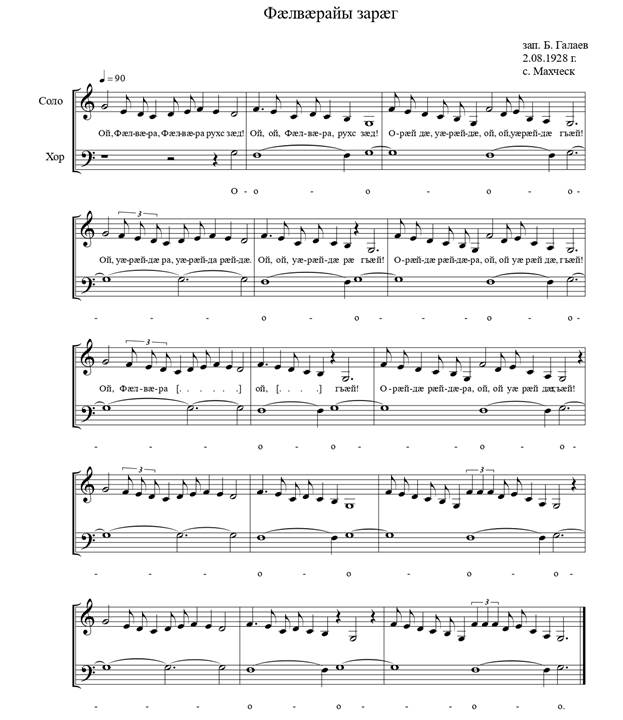
EXAMPLE 1. Fælværai zaræg ("Song in honor of Falvar")
The partial absence of subtext in our transcription of the song dedicated to Falvar, according to B. Galaev's recording, is due to the illegibility of the poetic component of the song. In addition, a significant part of the text is a series of complex or compound interjections. In this connection, we can conclude that most likely the performer remembered the melody, but did not remember the entire text, replacing the semantic parts with common exclamations such as: oh, gae, rae, yae, etc. Intonationally, the song "Falwara (deity)" is built in waves, mainly from the upper reference tone to the lower in the octave range. This sample has a two–phase structure of the song stanza, based on the conjugation of two basic consonances: the main one is the thesis (T) and the secondary one is the antithesis (A) (here and further we use the system of description of fret functions proposed by V. V. Korguzalov [Korguzalov V. V., p. 243]. In both phrases, there is a movement from the thesis through the antithesis and back (T→A→T). The musical-rhythmic form of a song consists of two unequal syllabic periods that make up one musical phrase. At the same time, the amount of musical time is stable in each phrase: the first period is 36 counting units, the second is 24. The musical and rhythmic embodiment of the three–syllable that completes both the first and second verse lines is also characteristically stable: q q h ; q q h. ; q q w The notation of the song "Falvarayy Zarag", recorded in 1936 as part of a folklore expedition to the North Caucasus by the Swedish ethnomusicologist and instrumentologist Ernst Emsheimer, also belongs to the author of the article and is being introduced into scientific circulation for the first time. The recording is stored in the Phonogram Archive of the Institute of Russian Literature of the Russian Academy of Sciences (Pushkin House) in St. Petersburg (EXAMPLE 2).
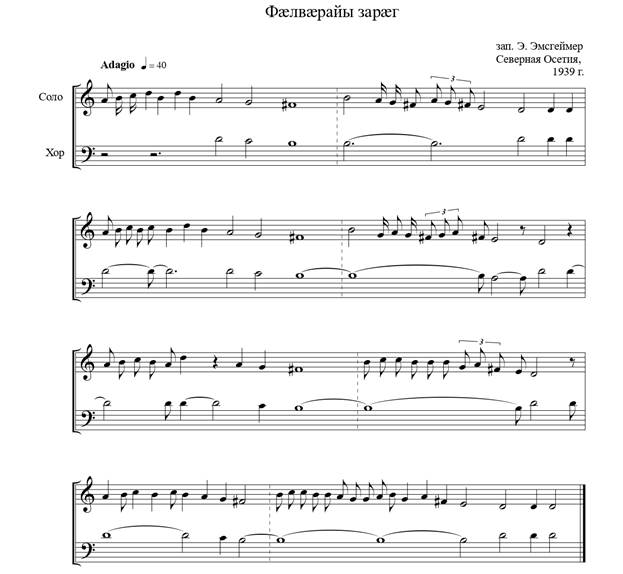
EXAMPLE 2. Fælværai zaræg ("Song in honor of Falvar")
Unfortunately, the poor quality of the audio recording caused by the natural aging of the media made it completely impossible to carry out textual decoding. The intonational development of this sample of the song "Falvarayy zarag" is based on the conjugation of the main support – thesis with a secondary – antithesis, moving from thesis through antithesis and back (T→A→T). The musical and rhythmic form of "Falvarayy zarag" is associated with the instability of the musical time of each syllabic period: 1 phrase: 26 and 20 counting units; 2 phrase 27 and 20 units; 3 phrase – 21 and 14: 4 phrase – 19 and 30 units. In turn, the syllabic period consists of two rhythmic stops, where the first is more variable, and the second is practically constant. As in the previous example, every second stop in the period is a three-syllable group, represented by the following options: e e h ; e h h ; q q h ; q q w ; h h w ; h q q ; h q h . As we can see, the variability of its performance is determined by the performance logic. The musical and typological analysis of the tunes of the song in honor of Falvar, as well as the data obtained during the study of other religious and mythological songs, provide the basis for an objective assessment of archival handwritten notations. The least typical in terms of musical style is the notation found in the archive of the Republican House of Folk Art [9, paragraph 28] (example 3).
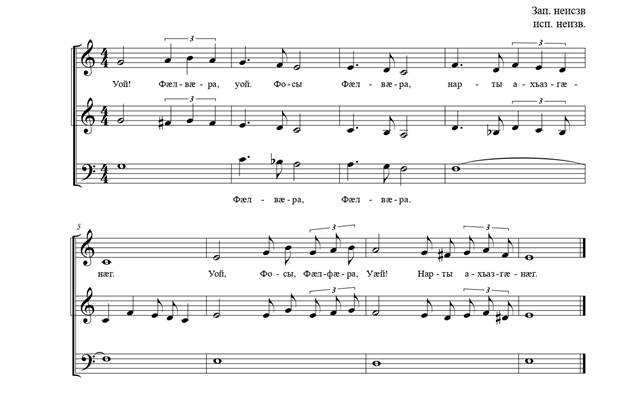
EXAMPLE 3. Fælværai zaræg ("Song in honor of Falvar")
This sample is presented in the volume of one stanza with harmonization for 3 voices, which is not typical for the folk song polyphony of Ossetians in general and for religious and mythological songs in particular (the only exceptions are samples of drinking and heroic songs recorded on the territory of South Ossetia). In addition, the notation has an even rhythmic pattern and a regular size, which also indirectly indicates the author's treatment of the folk song. It is interesting to note that a practically identical sample of the song with the name "Fælværayi zaræg" was found by us in the Scientific Archive of the SOIGSI [12, p. 124, d. 384] (example 4).
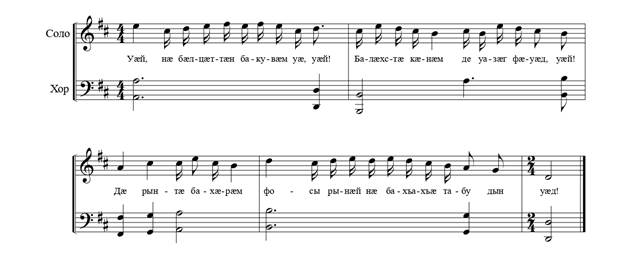
EXAMPLE 4. Fælværai zaræg ("Song in honor of Falvar")
This sample is more convincing in terms of texture, as it is recorded in the style of the basic two-voice bourdon type, characteristic of Ossetian choral songs. As for the intonation development, in both cases, attention is drawn to the fact of modulation towards the end of the stanza, which completely contradicts the peculiarities of the melodic development of Ossetian religious and mythological songs. Probably both of these variants may belong to the genre of epic songs based on a tirade-strophic composition, which in these cases was not fixed until the end of the stanza, but was interrupted in the middle of development. In addition, two samples of "Fælværayi zaræg" found in the Scientific Archive of the SOIGSI [8, p. 124, 256] (example 5) and in the archive of the Republican House of Folk Art [9, p. 28] (example 6) stand out from the general corpus of religious and mythological songs. In both cases, the notes, which were absolutely not convincing in terms of intonation and melody, were most likely written after listening to them from memory once, as evidenced not only by the unusual bass accompaniment, but also by a violation of the principle of prosody of the Ossetian language.
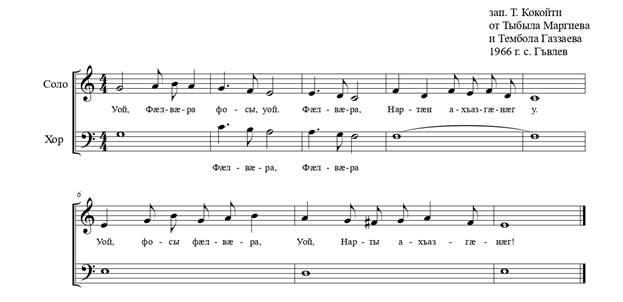
EXAMPLE 5. Fælværai zaræg ("Song in honor of Falvar")
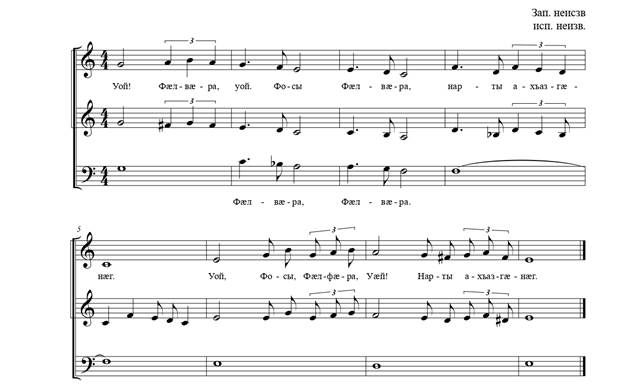
EXAMPLE 6. Fælværai zaræg ("Song in honor of Falvar")
Separately, it is worth considering a sample of a song from the Scientific Archive of SOIGSI (Tskhurbaev) "Fælværayi zaræg (Bedzenædzhi zaræg)" [13, d. 7]. The song was recorded by Ossetian composer Dudar Khakhanov in Kadgaron village from Agube Khautaty (example 7)
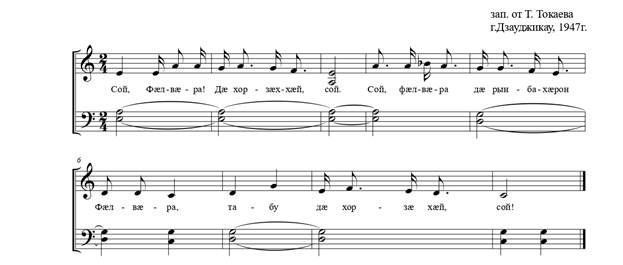
EXAMPLE 7. Fælværai zaræg ("Song in honor of Falvar") Judging by the name of the song, this sample belongs to the genre of epic songs, since Bejong is the hero of the epic. In our opinion, the notation is an author's treatment, as it demonstrates a clear compositional structure, a clearly rhythmized melodic line and strict proportionality of the compositional units of the song stanza, which is not typical for either religious-mythological or epic songs of Ossetians. Thus, it can be concluded that in the Ossetian tradition with the name "Falvarayy zarag" there were songs not only of religious and mythological content, but also belonging to the epic genre. As for religious and mythological songs, based on the analysis, it can be concluded that they are characterized by a texture typical of Ossetian folk song polyphony in general, which is "melodic recitations of a soloist (high tenor or baritone) against the background of a choir that pulls in unison the lower bass voice in alternating intervals of octaves, quarts and fifths to the upper solo voice" [14, 9]. The general logic of fret formation in the melodies of songs in honor of Falvar is associated with the change of two fret functions: the main and secondary. In addition, the songs of this genre are characterized by the stability of the musical and rhythmic embodiment of the three-syllable ending the verse lines. Over time, the decline of the cult of the patron saint of pets led to the complete oblivion of the religious and mythological songs of this group. The field research conducted by the author of the article, both as part of expeditions and independently, revealed that the song had completely fallen out of use.
The article is published in the version approved by the reviewers (after receiving a positive review recommending the manuscript for publication) with corrections made by the author (after receiving the editor’s comments, if any).
Read all reviews on this article
References
1. Miller, V. (1881). Ossetian studies. In Scientific notes of the Imperial Moscow University. Reprint edition: Vladikavkaz, 1992.
2. Abaev, V. I. (1958). Historical and etymological dictionary of the Ossetian language (Vol. 1).
3. Kochiev, K. K. (1985). The history of the Ossetian livestock cults Falvara. In IYONII, 29, 150-160.
4. Darchiev, A. V. (2013). Evolution of the functions of the deities of the Ossetian pantheon, Falvara and Mykalgabyr. In Historical, philosophical, political, and legal sciences, cultural studies and art studies. Questions of theory and practice (Vol. 12 (38), Part II, pp. 38-45). Gramota.
5. Chibirov, L. A. (1976). The folk agricultural calendar of the Ossetians. Tsukhinval: Iryston.
6. Chibirov, L. A. (1987). Periodical press of the Caucasus about Ossetia and Ossetians (Vol. 3). Tsukhinval: Iryston.
7. Khamitcaeva, T. A. (1992). Monuments of folk creativity of the Ossetians: Labor and ritual poetry of the Ossetians (G. A. Dzagurov, T. A. Salamova, D. G. Tmenova, A. A. Khadartseva, & T. A. Khamitcaeva, Trans.). Vladikavkaz: Ir.
8. Scientific archive of the North Ossetian Institute of Humanitarian and Social Studies. Art fund. Inventory 2.
9. Archive of the Republican House of Folk Creativity.
10. Salagaeva, Z. (2007). Iron adæmon sfældistad (Vol. 2). Vladikavkaz: Ir.
11. Takazov, F. M. (2017). Semiotic of the narrative of mythological songs of prayers of the Ossetians. In Izvestia of the SOIGSI? 26(65), 130-138. https://doi.org/10.23671/VNC.2017.65.9796
12. Scientific archive of the North Ossetian Institute of Humanitarian and Social Studies. Folklore fund.
13. Scientific archive of the North Ossetian Institute of Humanitarian and Social Studies. K. Tchurbaeva fund.
14. Galaev, B. A. (1964). Ossetian folk music. In Ossetian folk songs collected by B. A. Galaev in recordings, notated jointly by B. A. Galaev and E. V. Gippius (E. V. Gippius, Ed. & Intro.), pp. 7-20. Moscow: Muzyka.
Peer Review
Peer reviewers' evaluations remain confidential and are not disclosed to the public. Only external reviews, authorized for publication by the article's author(s), are made public. Typically, these final reviews are conducted after the manuscript's revision. Adhering to our double-blind review policy, the reviewer's identity is kept confidential.
The list of publisher reviewers can be found here.
The article "Religious and mythological songs in honor of Falvar in the Ossetian tradition" is devoted to a comprehensive analysis of the corpus of sacred songs dedicated to Falvar, a key figure of the Ossetian pantheon. The subject of the study is the peculiarities of functioning, as well as the typological features of songs in honor of Falvar. The author considers these texts as a single musical-linguistic cultural and ritual phenomenon. The research methodology is distinguished by its interdisciplinarity: field folklore studies, ethnomusicology, comparative historical analysis, structural-semantic and contextual methods. The research was based on the structural and functional method, in which the object was divided into parts, followed by an analysis of their interrelationships. The comprehensive use of data from ethnography, philology, folklore studies, and ethnolinguistics provided the study of this cult from a historical and ethnographic perspective. The relevance of the work is due to the growing interest in the preservation of intangible cultural heritage and the need for in-depth study of local Caucasian traditions in the context of Indo-European mythology. The scientific novelty consists in identifying the corpus of samples of religious and mythological songs in honor of Falvar, as well as its musical, stylistic and poetic features; in introducing new field materials into academic circulation and in a comprehensive reconstruction of the cult of Falvar through the prism of song texts, which makes it possible to clarify its functions and place in the Ossetian pantheon. The article has a clear structure and is written in a clear academic language. The logic of the presentation – from the description of the cult to the analysis of poetic and musical texts, their interpretation – is convincing. The bibliography demonstrates the fundamental work of the author and includes classical works, archival materials of funds on Ossetian studies, modern research and field materials. The author takes into account possible objections regarding the hypothetical nature of some reconstructions, based on a well-reasoned set of textual, ethnographic and comparative data. The conclusions of the article convincingly emphasize the role of the song cycle about Falvar as an essential element of preserving the traditional worldview of Ossetians. The research will arouse considerable interest among ethnographers, folklorists, ethnomusicologists, religious scholars and linguists, as well as among all those who study and preserve the cultural heritage of the peoples of the Caucasus. Having done considerable analytical work and field research as part of expeditions, the author comes to the conclusion that in the Ossetian tradition with the name "Falvarayy zarag" there were songs not only of religious and mythological content, but also belonging to the epic genre. Over time, the decline of the cult of the patron saint of pets led to the complete oblivion of the religious and mythological songs of this group. The value of the material is given by the fact that the song is now completely out of use. The article is an example of a modern scientific approach and deserves to be highly appreciated for publication in a scientific journal.
|





 © 1998 – 2026 Nota Bene. Publishing Technologies. NB-Media Ltd.


