|
Man and Culture
Reference:
Batarshin, R.R. (2025). On the Idea of Transforming the Stage Model: The Theatrical Potential of the Contemporary G. A. Tovstonogov Drama Theater. Man and Culture, 4, 1–16. https://doi.org/10.25136/2409-8744.2025.4.75078
On the Idea of Transforming the Stage Model: The Theatrical Potential of the Contemporary G. A. Tovstonogov Drama Theater
Batarshin Roman Raifovich
ORCID: 0000-0002-9687-1331
Senior Lecturer; Department of Russian Theater; Russian State Institute of Performing Arts (RGISI)
Chief Administrator; Bolshoi Drama Theater named after G. A. Tovstonogov
33-35 Mokhovaya St., Saint Petersburg, Russia, 191028

|
rbatarshin@gmail.com
|
|
 |
Other publications by this author
|
|
|
DOI: 10.25136/2409-8744.2025.4.75078
EDN:
FKFTVQ
Received:
07/05/2025
Published:
07/15/2025
Abstract: The established terminological pair "theatrical space" and "space of the theater" is widely used in art criticism, dramatically defining the difference in approaches to studying various phenomena, including modern theater. This article examines the problem of forming theatrical potential not so much from the perspective of organizing space as a whole, but through the application of a particular professional, theater studies "lens" – a view of the technological features of the stage itself. The author analyzes the experience of the last decade of the contemporary G. A. Tovstonogov Big Drama Theater under the leadership of A. Moguchy (2013–2023) in terms of the influence of the results of the renovation of the reconstructed building on the new potential for shaping the theater's image. The historical research method used in this article allows for a broader examination of the issue: from the technology of constructing a new stage platform to the idea of the technology for constituting a new theater. The methodological basis of the article consists of monographs by historians and theorists of theater, as well as interviews with practitioners in the contemporary theatrical process. The study includes an overview of the organizational and technological process of restructuring the BDT stage platform from 2011 to 2014. The author hypothesizes that changes related to the very architecture of the theater building and the rethinking of the technical possibilities of the stage in the academic theater directly corresponded to the literal sign of the beginning of a new chapter in the history of the G. A. Tovstonogov BDT. This research material is presented as unique and represents the first attempt at a scientific understanding of the significance of the specificity of the stage platform model on subsequent artistic and creative works that define the dynamics of theater development in historical perspective. The scientific novelty of the subject matter claims to assert the idea of the mutual influence of technological processes on the results of theatrical-dramatic action.
Keywords:
BDT, Moguchiy, Kochergin, Reconstruction, Stage area, Lifting and lowering platforms, Plungers, Turntable, Rotary ring, Transformation
This article is automatically translated.
The art of theater – from space to the type of stage Theatrical space and theater space as terms have long been scientifically and fundamentally established in the research of various theatrical phenomena. They comprehensively examine the specificity of diverse experiences in modern theater. This terminological pair is dialogical in its own way. From the point of view of the author of the article "Essential characteristics of the theatrical space and the theater space", Orlova E. V., "a real enclosed space in which specific practical activities of subjects providing intra-theatrical specifics are formed and implemented is called the theater space. And the "theatrical space" (ontological, ephemeral) is understood as the atmosphere that develops around theatrical art and determines the place of theater in culture" [1, p. 136]. Theater critic V. I. Maksimov also wrote about the problem of theatrical space in his article on the artistic phenomena of the St. Petersburg stage. In his opinion, "in our time, the traditional theater space is not a condition for a stage work. At least for the reason that there are no clear boundaries between the performance, the performance and the performative situation. Any space can be a theater venue" [2, p. 52]. Reflecting on the artistic and creative sides of the drama theater, the researchers hypothesized that the modern performance is fundamentally variable in its structure and is able to adapt to any physical territories. One way or another, the complex of judgments aimed at studying the specifics of a modern dramatic performance almost by default touches upon the issue of theatrical space. This problem turns out to be fundamental for studying the subject of theater as an art. Of course, in this regard, today's research base seems to be quite large-scale. But there is also a second side to this dramatic "coin." To analyze works of theatrical art not only from the perspective of the specifics of the theater space, but also from the perspective of a purely rigorous type of stage. Even today, the idea that the model of the theater stage itself, or the type of stage tablet, dictates the conditions for the game, is still very legitimate. If we study in more detail the question of the mutual influence of the type of play – stage – territory and the nature of the performance, we can come to a more complex problem. The technology of stage stages. We hypothesize that there is a direct relationship between the model of the stage (i.e., the type of its site) and the way the performance is organized. The role-playing option is dictated not just by the architectural features of the stage stages, but by their technological structure. Literally– the technique and technology of the stage generates the technique and technology of the performance (models of the world here and now). The stage structure is fundamental for theatrical art. The history of the theater is also inclined in favor of this idea. The historical movement of the development of the laws of the artistic worldview indicates that all types of art, with the exception of one, have "diverged" into two types in diametrically opposite ways: they appear to be either temporal or spatial. Let's say music is a purely temporary art, while painting or sculpture is spatial. The territory of the theater, which clings to its genetic element – drama – implies an exceptional contradiction, which decisively distinguishes it from all other types of art. By its nature, theater is a space-time art. From this perspective, the nature of the drama theater should be considered as a chronotope existing in a special time-spatial continuum. According to the ideas of the thinker M. Bakhtin, the concept of chronotope explains "the essential interrelation of temporal and spatial relations" [3, p. 234]. And there is already a dramatic contradiction in this. Time moves rapidly, but space does not: it tries to keep itself in a stable spatial form. The drama of such a situation can be noticed if the scenic space, which is formed with the help of an artistic model and creates the volume of the picture of life "here and now", decisively makes a choice in favor of changing itself. Previously, it was customary to "count off" theater from literature. Drama and role – they were the dominant ones. But a theater based on literature, the so—called literary theater, is an 18th-century theater in a European version. Sometimes it has already become aphoristic to "surrender to the role" — this is a long-standing tradition and today quite rightly argues with the theater of the XXI century. There is a "shift" in favor of today: from "playing a role" to "playing with a role." And this change in the conditional formulation is directly related to the genesis of the drama theater – to develop its own independent. That is, it is becoming more and more a theater. The German theater researcher, Max Hermann, was the first to become theater-centric. He did not come from literature, but from the theater, its independence. He had to radically rethink the relationship between text and performance. According to the founder of theater studies, the foundation of the art of theater is not literature at all, but performance: "performance is the most important thing" [4, p. 52]. Herman himself interpreted the concept of a performance as follows: a unique situation arises, the dynamics of which are sometimes difficult to control, when "actors find themselves united by time and space with a certain number of viewers, whose mood, desires, knowledge, ideas, etc. can be very different from each other" [4, p. 63]. Obviously, Max Herman set the "source code"– the site, not the word.
Our domestic experience in theater science has actualized this idea of the independence of theatrical art, which was set by Herman. Theater thinker A. A. Gvozdev developed Herman's historical and theatrical thought, calling it a change of theater systems. Based on the two types of stage platforms, he established as a dichotomy two different theater systems as such. It is the stage platforms: the box stage and the arena stage. The sequence of such a movement of the theater turned out to be categorically indicative. A. A. Gvozdev wrote that it is "space that determines the way an actor plays and, consequently, the repertoire performed by the actor" [5, p. 35]. It turned out that in many ways it is the principle of the stage design that dictates the actor's defining feature – acting technique. In one case, this is a histrionic actor who needs to work with literally his whole body from all sides, in the other case, we are talking about a performer who finds himself in the conditions of his stage existence outside the fourth wall, where technically a single angle of the actor's body is required. The pattern thus formed is as follows: platform – actor – acting technique. This is also where a circumstance arises that is directly related to the principle of the actor's relationship with who his character is "here and now." In contrast to the situation in which the principle of the fourth wall is involved, where the actor-role-spectator that constitutes the theater is always "playing a role," a completely different behavioral position comes into play, dictated by the principle of space, where the viewer is around the actor. In this situation, there is no integrity as such. The opposite arises – by no means role–playing, but, as is customary to follow the logic of "breaking" the fourth wall, openly artistic. Considering this circumstance, we define such a definition as literature as the last link. The type of role is dictated by the absolute conditions of the scene. The stage is able to involve the viewer in an open theatrical game and is already reluctant to tell him, for example, everyday stories from its stage. The radical nature of spatial changes in the movement of theatrical history was set initially. In this way, the idea of the theater became theater-centered.
The device model of the Main BDT stage. Reconstruction experience In the context of the analyzed topic, the example of the St. Petersburg Drama Theater named after G. A. Tovstonogov turned out to be indicative. During the three-year period (2011-2014), the complex of the Fontanka Theater building was subject to "Reconstruction, restoration and technical re-equipment of the building." For the first time, a large-scale renovation of all rooms and decorations was organized in the theater space, designed by architect Ludwig Fontana in 1876-1877.
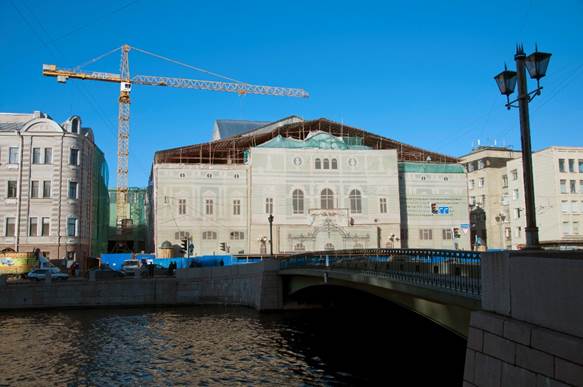
Fig. 1 Facade of the BDT building. 2011.
The main thing is that during it, a technological reconstruction of the type of scenic design of the tablet of the Main Stage was carried out. This was the first time in the history of the theater building that this change had occurred. As a result of the conducted constructions, the key was realized for any theater of the XXI century. The model of the stage with a rotating "circle" and "ring", which provided the spaces for theater performances in the 20th century, was replaced by a completely different principle of the stage tablet device – plungers (lifting and lowering platforms). Instead of horizontal movement, the opposite direction of the moves was set – "vertical-like". Literally horizontal, replaced by vertical. The new stage model has been adapted to fundamentally different directions, speeds, and configurations. Both capable of being technologically exploited and theatrically setting the parameters of the artistic worldview of the 21st century.
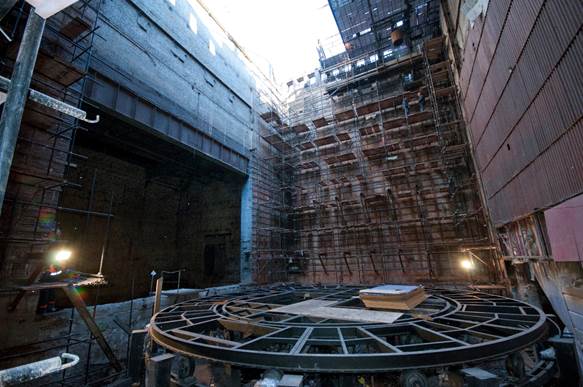
Fig. 2 Dismantling of the lower machinery of the stage – the turning circle and the ring. The year is 2011.
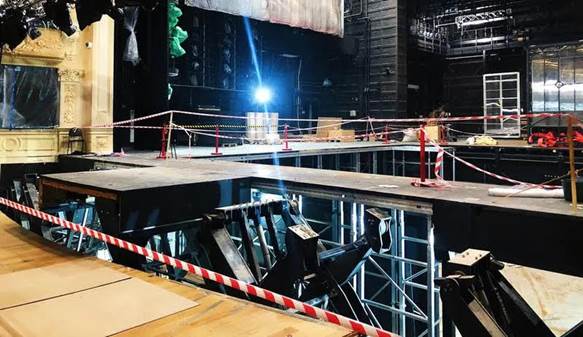
Fig. 3 Installation of plungers (lifting and lowering platforms) The main stage of the BDT. 2013.
The chief artist of the BDT, E. S. Kochergin, who has served this theater for more than half a century, stated in an interview that the project for the reconstruction of the BDT's main stage was not developed on the eve of the reconstruction of the theater building in 2011-2014. Back in the early 2000s, three figures stood at the origins of the development of a plan for the reorganization of the "rethought" stage model: E. S. Kochergin, head of the artistic and staging department V. P. Kuvarin, as well as the artistic director of the theater (1989-2007) K. Y. Lavrov. In those years, in response to the demands of the post-perestroika country, a "modern project with plungers was prepared for implementation, that is, the stage is divided into modules that can rise and fall in any combination. Everything is as it should be for the present directing" [6]. The mechanization of the stage with a lifting and lowering system "created a tempting prospect for the directors of the new formation" [7]. The theater has the opportunity to "break" the flat plane of the stage and change its relief in various ways. As evidenced by the Western European history of the theater, the plunger system originated in the second half of the 19th century. In 1870, for the first time, lifting and lowering platforms were tested by the French engineer Keruel at the Gethe Theater in Paris. And then it became clear that the principle of the stage design is not so much a matter of technique as technology. The theatrical 20th century seriously realized that the technology of the theater's stage platform is the technology of the performance itself. His creation, his composition, his search for linguistic means of expression. This turned out to be directly related to the profession of directing. The physical sensation of the stage space through the vertical category became a priority in the search for a new stage language. "The biggest problem is the stage floor, its flatness," wrote the director of the Sun. Meyerhold. – As a sculptor crushes clay, let the floor of the stage be crumpled and transformed from a wide-spread field into a compactly assembled series of planes of various heights" [8, p. 155]. The modernist Meyerhold did not artistically strive for the ideas of introducing plungers. History is an indicator of that. Connecting two centuries, actualizing the past in the present, comprehending the experience of the theater of the XX century in modern realities, the main artist of the BDT Kochergin defined the historical circumstance of the accomplished change in his own way. In a conversation about the difference in the meanings of the two types of stage platforms, he argued that the principle of introducing the turning "circle" and "ring" into the tablet stage of drama theaters is "the theatrical philosophy of the early twentieth century, ideas of that time that have nothing to do with us" [6]. Theaters of the Soviet years were almost tendentiously equipped with similar devices. It was a trend of the times. However, the tradition of the "circle" and "ring" scenes unwittingly passed into the practice of the theater of the XXI century. Of course, the turn of the 20th and 21st centuries required its own rethinking: ideological, ideological, technological. The change of eras was equal to the change of tasks facing theaters in the early 2000s. Quite a few institutions were ready for this challenge of the time. And the BDT was at the forefront.
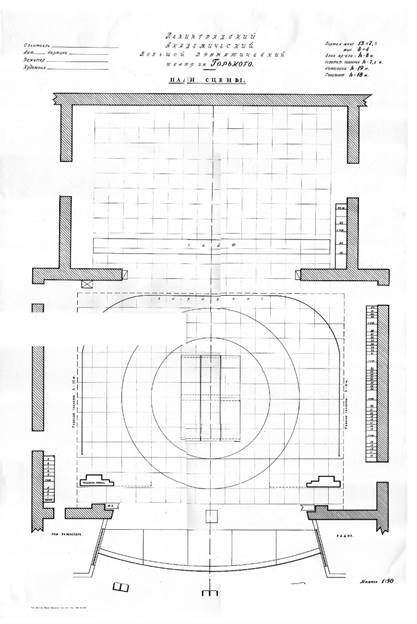
Fig. 4 Technical plan of the lower machinery of the Main stage of the BDT. 1980.
History decreed that in 2007, due to the passing of K. Y. Lavrov, the powerful staff of the Bolshoi Drama Theater temporarily lost its bearings for the further path: both organizational and administrative, and organizational and artistic. In the same year, the successor of K. Y. Lavrov, the creative heir of the theater of the era of G. A. Tovstonogov, director T. N. Chkheidze, did not make the changes that Lavrov was very radically ready for. Instead of the expected transformations of the stage structures, the tablet of the Main Stage still retained the inset "circle" and "ring". According to this technological "principle", performances were staged until 2011, i.e. before the start of reconstruction work. It was only in 2014, by the time the renovation of the theater building complex was completed, that the theater managed to implement a project to develop a tablet device for the Main Stage, which "returned the idea of the first one, with modules, but in a slightly different way. Because of this, the opening of the theater was postponed for six months" [6].
As a result of the reconstruction, in addition to the reconstruction of the organization of the stage, the sound, lighting, and video equipment were thoroughly updated. The updated technology of the space was obviously adapted in favor of the "artistic" – to generate and broadcast new meanings of theatrical forces. Without exception, all the stage workshops and production workshops remained in the same premises, but with new equipment. "This is great," said E. S. Kochergin, "because we had very ancient machines, you wouldn't believe it, since the 30s. And in the picturesque hall there were homemade lamps with reflectors made of aluminum basins... Now everything will be new" [9]. The changes also affected the auditorium of the Main Stage. By increasing the distances between the rows of seats, the developers of the hall, which was "reformed" with new ideas, had to reduce the number of seats by almost half. Instead of 1,200, the modern BDT hall accommodates 750 seats. Kochergin, in one of his interviews, very humorously argued that "you will not see such wide aisles in any theater in the city - you can walk calmly without fear of stepping on a lady's foot! But the viewer is more comfortable" [6]. Obviously, this change worked in favor of the audience, because it is, as before, for the modern theater "an obligatory part of the performance system" [10, p. 238]. A theater like BDT, which is faithful to the precepts of its history, strives to actualize the accumulated experience of the rich past of the 20th century in the present day. As usual on the territory of the theater, there is always a reverse side of the dramatic "coin". It means that the reconstruction of the theater, which was so large-scale in terms of the range of works, in addition to the charge of new impulses (the latest technologies and equipment), launched something else. The desire to preserve the image of BDT as a cultural code and the genius of the place was conceptualized quite significantly. The point is that the theater managed to intentionally and strategically preserve the legacy of its categorically perfect history of the 20th century. Particular importance should be given to the transformation of the BDT museum space. It is noteworthy that exactly one week after the premiere of the very first performance of the BDT "Don Carlos" - on February 22, 1919 – the artistic council of the theater appealed to Gubpolitprosvet with a request to purchase 25 sketches by the artist Shchuko for the performance. The management realized and foresaw that the BDT was "not a momentary enterprise, but a real theater, and from the very first days it was necessary to preserve and "collect" its history" [11]. Almost immediately, along with the theater itself, its museum appeared. From then to the present, the exposition of the BDT museum begins with two authentic sketches for the play "Don Carlos". And if earlier, before the reconstruction of the theater, a large museum space was dedicated to the theater of the Tovstonogov era, "now the exposition is largely different, reflecting the entire history of the theater" [11]. The legendary spaces of the academic theater also turned out to be artifacts that fulfill the role of actualizing the past in the present. The office of G. A. Tovstonogov, the makeup room of K. Y. Lavrov, as well as the famous dressing room with a painted ceiling, which in previous years housed actors S. Yursky, A. Garichev, O. Basilashvili — all this attempted to organize itself as a historical authentic art object, but actualized for the modern reality of life. The ignition of drama between tradition and innovation was manifested with all its strategic might.
The formation of modern BDT. Opportunities and ways of implementation
It is typical for researchers of the modern theatrical process to consider the activities of the BDT under the artistic direction of director A. Moguchy from the point of view of the artistic results of stage statements. The subject of their analysis are the performances staged by the artistic director at the BDT in the period from 2013 to 2023. The creative life of the legendary theater came to the professional attention of the theatrical community on the occasion of the arrival of the new artistic director, director Andrei Moguchy, in 2013. A fairly large-scale volume of theatrical and critical thought is devoted to the stage works in the BDT authorship of Moguchy. The productions he performed on the stage of the academic theater attracted by no means immodest theatrical attention. Of course, the request to form a completely different image of the collective, while preserving traditions and simultaneously updating the brand of the institution, is a very significant conversation in favor of initiating a new theater. New names, new performances, trends. Categorically, all these vectors of movement were set at the very beginning of the implementation of the programmed strategic ideas for the development of the theater. It is worth considering that having a creative team and its corresponding resources is quite sufficient for a rapid start. In the case of BDT, these opportunities turned out to be exemplary, literally historical. Theatrical opinion very stereotypically calls for "counting down" the start of the "new BDT" under the leadership of Andrei the Mighty from the appearance of his first author's performances in it. This circle includes "Alice" starring Alice Freundlich (2013) on the stage of the Kamennoostrovsky Theater, and the play "What to Do" based on the novel by N. Chernyshevsky (2014) – the first work of the Mighty on the Main stage of the BDT after reconstruction. Of course, theatrical critical thought largely sets the "starting points" of the historical movement of the "new BDT", the BDT authored by Andrei the Mighty. This idea of the theatrical community is very significant and has all the reserves to be decisive in the analysis of the creative and organizational activities of the BDT of the last decade.
Our research hypothesis is based on the fact that today the last decade of the Bolshoi Drama Theater's life is already history. And in many volumes, the accumulated material can turn into all sorts of scientific and theatrical discoveries in the historical perspective. From the point of view of today, it is essential to consider the activities of the BDT 2013-2023 as a theatrical and cultural capital formed by modern history. With the absolute authorship of the A. Mighty Theater, the last pages of his chronicle deserve separate independent studies. Based on this, we propose to consider the author's period of the BDT of the Mighty, which has become meaningful, from a special theatrical and essential angle of the research view. The novelty of this study is determined by the idea that the genesis of the "new BDT" was laid down by the premieres of the first productions of the Mighty that knowingly ascended to the stage. Its historical beginnings and root origins are the result of the reconstruction of the theater building complex. It was she who, actualized by the architectonics of the great historical heritage of the theater, gave birth to the opportunity to "build" an author's theater in her space. There is reason to believe that the substantive changes that affected the principle of the stage tablet device directly responded to the direction of the Mighty, as well as the way to "see" the world, including the stage. The changes that were very decisive for the academic theater, related to the reconstruction of the main building complex, namely, the technological transformation of the tablet device of the stage stages, set the trajectory for a new path of BDT. Deliberate synchronicity and asynchrony spark drama between each other. There are obviously many ways to develop the "new" theater, and the palette of its cultural and creative alternatives is intentionally diverse. Here, in fact, there is a special multiplicity and multifunctionality in choosing a strategy for the development of modern BDT. The principle of technological stage design has become consistent with the principle of organizing the stage space of a modern performance. Developing an up–to-date stage language that allows to create a new author's theater, A. Moguchy felt the need for the main thing - the nature of the theater: "For me, theater is always primary. And a play or a literary text is the motivation and the basis to push off and jump towards a performance that is primary and self—sufficient" [12]. Continuing the thought, the director stated: "we proposed a construction stage that can be partially or completely modified, which can gradually be equipped with any modern mobile equipment, any number of lifting and lowering mechanisms located at any point on the stage" [13]. A completely different way of understanding space is an absolute for new beginnings. From the perspective of the transformation of the architectonics of the theater's scenic complex, this article attempts to hypothesize that it was these spatial, particularly meaningful, modifications of the Main Stage that "launched" the modern Tovstonogov BDT. They have become fundamental – prehistory. Assessing the potential of the BDT theater space more than 10 years ago, it should be noted that the new space (the type of stage) and the new time (the artistic world of the authorship of A. Moguchy) dramatically intersected. In this case, the experience of the reconstruction is not a technical re-equipment of the theater space. On the contrary, the result of the renovation, firstly, made it possible to assess the theatrical potential of the institution, and secondly, to touch upon the conclusion that the artistic mindset of director A. Moguchy was in unison with the opportunities that opened up to the BDT in 2014. In other words, the spatial category (taking into account the technological nature of stage implementations) is fundamental for the author of both the performance and the Mighty Theater. The vector of artistic searches directed by Andrey Moguchy is a phenomenon that deserves detailed attention. His creative quest as a great artist obviously goes beyond the usual understanding of the drama theater, sending us into the field of interdisciplinary arts, balancing on the edge of theater, performance, and installation. Olga Chepurova, a theater researcher, in an article devoted to the problems of the creative method of director Andrey Moguchy, outlines to us a synthetic model of para-theatrical forms, which combine to create a new artistic phenomenon. "It is obvious that the director's method, which inherits but does not fit into the framework of the traditional understanding of drama theater, forces us to look for a solution where genres, directions, forms merge, rethink and give birth to something new" [14, p. 257], O. Chepurova writes. Opportunities are needed to implement what has been identified. And they are fundamentally technological in nature. The arrangement of the Mighty's performances themselves is extremely technological. He staged such performances as "Alice", "What to Do", "Three Fat Men. Episode 1", "Three fat men. Episode 2" artistically and organizationally determine the functionality of plungers (lifting and lowering platforms). In the performances of the Mighty, vertical and vertical movement as such turned out to be meaningful and semantic. This is inherent in the artistic exploration of the modern world, which, from the director's point of view, acquires various heights and speeds – ups and downs. It is obvious that the technological effectiveness of the stage mechanization devices used expresses theatrical meanings, the author of which was Andrey Moguchy. It is obvious to assume that the role function of the actors is also interdependent on the configuration of the positions of the stage stage. The type of performance of a modern hero by a dramatic actor is now dependent on the very configurations of technical and scenic capital. The nature of the "theatrical" is revealed here: a person's place in the world (his role) is directly dependent on the space of life (the model of the scenic world). And the world of modern performance today is determined by the technological capability of the stage and its types.
A special date fell on September 26, 2014, when the band returned to the renovated spaces of the theater. Marking the foreshadowing of the turn of a new era of BDT, I recall the landmark speech of the writer Daniil Granin, who was present that evening in the auditorium of the Bolshoi Drama Theater. The statement "We don't need another theater, we need a BDT" [15] turned into a metaphor for the beginning of a new path. The completion of the great theater of the XX century turned out to be obvious, which, obviously, the Bolshoi Drama Theater will not forget. Based on this, the decisive spatial change that determined the transformation of the tablet device of the Tovstonogov BDT stage as a result of the reconstruction work carried out in the complex of the main theater building (2011-2014) marked the beginning of a new era. As evidenced by the science of theater, the stage space is primary for the theater. It should be assumed that the stage "field" of the BDT turned out to be "cleared" for writing new pages of its history. The new configuration of the stage equipment and machinery, in fact, became a sign of the beginning of not only a new history of the Bolshoi Drama Theater, but also a sign of the opportunity to launch a new fundamentally original theater. The main change that we have recorded as a result of the three-year reconstruction is related to the "abandonment" of the type of stage tablet with a rotating "circle" and "ring" in favor of structurally integrated lifting and lowering platforms in the mechanization of the Main Stage stage. The story has "rebooted". Modern times have gained a new space, as well as vice versa. Obviously, the reconstruction was not the prehistory of the modern BDT, but a full-fledged history. The story of a theater that is becoming, but remembers its traditions.
The article is published in its final version as approved following the last positive peer review recommending acceptance for publication. It incorporates revisions made by the author in response to prior negative peer review reports that did not recommend publication. All peer review reports, including initial negative reviews, are published in open access alongside the article. All versions of the author’s revisions are archived in the publisher’s repository and may be made available upon reasonable request in accordance with Elsevier’s editorial policies and applicable data availability requirements.
Read all reviews on this article
References
1. Orlova, E. V. (2010). Essential characteristics of theatrical space and the space of the theater. Analytica of Cultural Studies, 3, 132-143.
2. Maximov, V. (2018). The theatrical space as a criterion of artistic meaning or its absence on the modern stage. Questions of Theater Proscaenium, 1-2, 48-58. EDN: MFWWVD.
3. Bakhtin, M. M. (1975). Questions of literature and aesthetics: Studies of different years.
4. Fischer-Lichte, E. (2015). The aesthetics of performativity. EDN: YRVIRR.
5. Gvozdev, A. (1926). On the change of theatrical systems. On Theater.
6. Kocherhin, E. (2025). Andrei Moguchiy and Eduard Kocherhin on the new life of BDT [Interview conducted by Dmitry Tsilikin]. Sobaka.ru. Retrieved from https://www.sobaka.ru/entertainment/theatre/37053
7. Bazanov, V. V. (1976). Technique and technology of the stage.
8. Meyerhold, V. (1968). On the staging of "Tristan and Isolde" at the Mariinsky Theater on October 30, 1909. In V. Meyerhold (Ed.), Articles, letters, speeches, conversations (Vol. 1).
9. Tsinkler, E. (2014). The main stage of BDT reopened in St. Petersburg after reconstruction. Rossijskaya Gazeta. Retrieved from https://rg.ru/2014/10/02/rekonstrrukcia.html
10. Barboy, Y. M. (2011). The evolution of constitutive parts. In Introduction to Theater Studies (pp. 233-244).
11. Moguchiy, A. (2021). BDT became a tectonic shock for me [Interview conducted by Galina Stolyarova]. Vedomosti. Retrieved from https://www.vedomosti.ru/lifestyle/characters/2021/07/22/879270-bdt-stal-vstryaskoi?ysclid=l9yhg5a3j4960501448
12. Moguchiy, A. (2025). Andrei Moguchiy: "I have long stopped being a spectator" [Interview conducted by Olga Romantcova]. Official Portal Culture.RF. Retrieved from https://www.culture.ru/materials/255907/andrei-moguchii-ya-davno-perestal-byt-zritelem
13. Kozlova, A. (2025). The opening of BDT is postponed to May 2014. Sobaka.ru. Retrieved from https://www.sobaka.ru/entertainment/theatre/17680
14. Chepurova, O. (2019). Andrei Moguchiy: From big ideas to a great dramatic theater. A brief history of the formation of the method. Herald of the A. Ya. Vaganova Russian Ballet Academy, 1, 256-271.
15. Dmitrevskaya, M. (2025). "BDT. Return". Farewell. Transformation. Blog of the St. Petersburg Theater Journal. Retrieved from https://ptj.spb.ru/blog/bdt-vozvrashhenie-proshhanie-prevrashhenie
First Peer Review
Peer reviewers' evaluations remain confidential and are not disclosed to the public. Only external reviews, authorized for publication by the article's author(s), are made public. Typically, these final reviews are conducted after the manuscript's revision. Adhering to our double-blind review policy, the reviewer's identity is kept confidential.
The list of publisher reviewers can be found here.
The reviewed text "Towards the idea of transforming the stage platform Model: the theatrical potential of the modern Tovstonogov BDT" is more of a journalistic statement about the Tovstonogov Bolshoi Drama Theater than a research paper. This is reflected in the lack of a clear text structure, chaotic chronology, and stylistic features ("On September 26, 2014, the band returned to their native walls. For the first time, the new artistic director of the Bolshoi Drama Theater, Andrei Moguchy, crossed the threshold of the reconstructed theater.… Kochergin said in one of his interviews that "you won't see such wide aisles in any theater in the city - you can walk safely without fear of stepping on a lady's foot! But the audience is more comfortable." Obviously, this change worked in the viewer's favor. With this gesture, BDT expressed the idea that the theater is for the audience.") The bibliographic list of the work consists of 11 texts, 6 of which are publications in electronic media. The central plot of the text is somewhat perplexing, namely the reconstruction and technical re-equipment of the Fontanka Theater building, completed in 2014, which the author evaluates extremely complimentfully, repeatedly dwelling on the "abandonment" of the type of stage tablet with a rotating "circle" and "ring" in favor of structurally integrated lifting platforms in the mechanization of the Main Stage.lowering platforms: "And this shift turned out to be radical. The story has been rebooted. A new time has met with a new space. Obviously, this was not the prehistory of modern BDT, but the real story. The story of a theater that is becoming, but remembers its traditions." Considering that the text was submitted for review in 2025, it would be logical not only to state the fact of the renovation, with all its advantages, but also to assess how the innovations carried out affected the development of the theater in the next ten years. The title of the text contains the phrase "the theatrical potential of the modern Tovstonogov BDT," and if the text had been presented in 2014, the author could indeed have talked about the renewed potential of the theater, but 11 years later the potential was either realized or not realized, and the author could have found quite specific material in the form of productions of the same It's too powerful to conclude whether the abandonment of the rotary ring in favor of plungers is so radical. Instead, the author scatters a variety of texts throughout the text, which are not supported by arguments, i.e., statements, achievements, etc. - compliments to the theater and its creative team ("Deliberate synchronicity and asynchrony ignite drama among themselves. There are obviously many ways to develop the "new" theater, and the palette of its cultural and creative alternatives is intentionally diverse. Here, in fact, there is a special multiplicity and polyfunctionality in choosing a strategy for the development of modern BDT ..."). If any part of the text looks like a statement of a problem, it is "From the point of view of the transformation of the architectonics of the theater's scenic complex, this article attempts to hypothesize that it was these spatial, particularly meaningful, modifications of the Main Stage that "launched" the modern Tovstonogov BDT. They have become fundamental – prehistory." In this case, the hypothesis is not proven, because the author simply does not consider the development of the theater after the renovation. The text in this form has no scientific value and can rather be used as an advertising and journalistic (and 11 years late) statement. Scattered throughout the text without systematic references to the history of the theater do not save the situation. The work requires fundamental deep processing.
Second Peer Review
Peer reviewers' evaluations remain confidential and are not disclosed to the public. Only external reviews, authorized for publication by the article's author(s), are made public. Typically, these final reviews are conducted after the manuscript's revision. Adhering to our double-blind review policy, the reviewer's identity is kept confidential.
The list of publisher reviewers can be found here.
The subject of the research in the article submitted for publication in the journal "Man and Culture", as the author reflected in the title ("Towards the idea of transformation of the stage platform model: the theatrical potential of the modern Tovstonogov BDT"), is the role of transformation of the stage platform model in expanding (the object of research) the creative potential of the modern Tovstonogov BDT. A. Tovstonogova. Throughout the article, the author compares the object and subject areas of research both by reviewing the scientific literature on the topic and analyzing the results of the renovation carried out in the theater (2011-2014). The role of transformation of the stage platform model is considered by the author in the context of an actual theoretical discussion about the functions and essence of the theater space. The empirical material (the results of the renovation of the BDT theater space) is analyzed in a historical and biographical context, which makes it possible to note the connection between the stages of the theater's development and its theatrical space. The author noted that modern theater criticism still focuses on personalized assessments of the development of the play (new directors, new actors, dramatic premieres, etc.), ignoring the essential role of the transformation of the stage model in expanding the creative potential of the theater. The theoretical grounds considered by the author for changing the very nature of theatrical communication within the framework of specific productions (performances), due to a differently formed communicative space and going beyond the conservative framework of a "literary" or "personalized" theater, really allow us to expect a new historical stage in the development of the creative potential of the BDT due to the renovation of the theater space. The author quite reasonably concludes, "that the stage field of the BDT turned out to be cleared for writing new pages of its history. The new configuration of the stage equipment and machinery, in fact, became a sign of the beginning of not only a new history of the Bolshoi Drama Theater, but also a sign of the opportunity to launch a new fundamentally original theater. The main change that we have recorded as a result of the three-year reconstruction is related to the “abandonment” of the type of stage tablet with a rotating “circle” and “ring” in favor of structurally integrated lifting and lowering platforms in the mechanization of the Main Stage stage. The story has “rebooted". New time has found a new space, as well as vice versa." Thus, the subject of the research is considered by the author at a high theoretical level, and the article deserves publication in a reputable scientific journal. The research methodology is based on the principles of a comprehensive analysis of the role of transformation of the stage platform model in expanding the creative potential of the Tovstonogov BDT, interdisciplinarity and objectivity of the study of modern theatrical life. The author's methodological complex, based on the current developing theory of theatrical space and including techniques of structural-semiotic, dialectical-dialogical and historical-biographical approaches, is fully relevant to the scientific and cognitive tasks being solved. The author's conclusions and generalizations are trustworthy. The author justifies the relevance of the chosen topic based on a discussion with colleagues (E. V. Orlova, V. I. Maksimov) by the fact that "there is a direct relationship between the model of the stage (i.e., the type of its site) and the way the performance is organized. The role-playing option is dictated not just by the architectural features of the stage stages, but by their technological design." The hypothesis put forward by the author has been comprehensively considered and sufficiently substantiated. The scientific novelty of the study, which consists in considering the role of transformation of the stage platform model in expanding the creative potential of the Tovstonogov BDT based on the current theory of theatrical space, deserves theoretical attention. The author's text style is generally scientific, but it is in stylistic and design details that it is possible to improve the quality of the planned publication.: 1) there is no dot at the end of the subheadings highlighted in a separate line; 2) due to the frequent use of "years" and "centuries", it would be appropriate to comply with the editorial requirement for their abbreviated design (see https://nbpublish.com/e_ca/info_106.html ) – it will immediately become easier to read the text; 3) there are complex subordinate expressions that lose their clarity in reading (for example: "During the reconstruction work ...", "... the sound, light, and video equipment were updated", "And here the choice fell in favor of not just equipment with modern "stuffing", but above all, the emphasis was placed on the desire to develop a technologically advanced space that could be capable of accumulating artistic means of expression new theatrical meanings") – the reviewer recommends that the idea be formulated more clearly, taking into account the norms of the ratio of everyday and theoretical (terms) vocabulary. The structure of the article is subordinated to the logic of disclosure of the results of scientific research. The bibliography reveals the problematic field of research well, it is designed without significant violations of the requirements of the editorial board and GOST. The appeal to the opponents is quite logical, consistent and sufficient: the author tactfully and argumentatively participates in theoretical and theatrical-critical discussions. The article is of interest to the readership of the magazine "Man and Culture" and, after minor stylistic and design improvements, could claim to be in the TOP 5 articles of the month of the publisher.
Third Peer Review
Peer reviewers' evaluations remain confidential and are not disclosed to the public. Only external reviews, authorized for publication by the article's author(s), are made public. Typically, these final reviews are conducted after the manuscript's revision. Adhering to our double-blind review policy, the reviewer's identity is kept confidential.
The list of publisher reviewers can be found here.
The author submitted his article "Towards the idea of transforming the stage platform model: the theatrical potential of the modern Tovstonogov BDT" to the magazine "Man and Culture", in which a study of the role of theatrical space in the art of modern theater was conducted. The author proceeds from the study of this issue from the fact that the modern performance is fundamentally variable in its structure and is able to adapt to any physical territories. Therefore, it is necessary to analyze the works of theatrical art not only from the perspective of the specifics of the theater space, but also from the perspective of a purely rigorous type of stage. According to the author, the very model of the theater stage site, in other words, the type of stage tablet, dictates the conditions for the game. The relevance of the research topic is determined by the need to systematize and broadcast experience in the field of the intersection of the spatial potential of theater and directing skills. Accordingly, the purpose of the study is to reveal the potential of interaction between a modern technological stage and the skills and experience of theatrical management using the example of the Tovstonogov Bolshoi Drama Theater. The methodological base consists of an integrated approach, including general scientific methods of analysis, synthesis, description and systematization. The theoretical justification was provided by the works of such researchers of theater critics as Max Herman, A. A. Gvozdev, V. I. Maksimov, E. V. Orlova, and others. The author uses the example of the reconstruction of the Tovstonogov Bolshoi Drama Theater and the creative experience of A. Moguchy as the artistic director of the BDT as an empirical material. Based on the analysis of the scientific validity of the problem, the author comes to the conclusion that theatrical space and theater space as terms have long been scientifically and fundamentally established in the research of various theatrical phenomena, and today's research base seems to be quite large-scale. They comprehensively examine the specificity of diverse experiences in modern theater. A set of judgments aimed at studying the specifics of a modern dramatic performance touches upon the issue of theatrical space. This problem turns out to be fundamental for studying the subject of theater as an art. The novelty of this study, as defined by its author, lies in the fact that the genesis of the "new BDT" is laid down by the premieres of the first productions of the Mighty that knowingly ascended to the stage. Its historical beginnings and root origins are the result of the reconstruction of the theater building complex. It was she who, actualized by the architectonics of the great historical heritage of the theater, gave birth to the opportunity to "build" an author's theater in her space. To achieve the purpose of the research, the author consistently puts forward and proves two hypotheses. First, there is a direct relationship between the model of the stage (i.e., the type of its site) and the way the performance is organized. The role-playing option is dictated not just by the architectural features of the stage stages, but by their technological structure. The author's second hypothesis is that the decisive spatial change that determined the transformation of the tablet device of the Tovstonogov BDT stage as a result of the reconstruction work carried out in the complex of the main theater building (2011-2014) marked the beginning of a new era. And in many volumes, the accumulated material can turn into all sorts of scientific and theatrical discoveries in the historical perspective. From this point of view, the author examines the activities of the BDT 2013-2023 during the author's period of A.A. Moguchy's BDT from a special theatrical and essential angle of research as a theatrical and cultural capital formed by modern history. The author comes to the conclusion that the new configuration of the stage equipment of the lower machinery has become a sign of the beginning of not only a new history of the Bolshoi Drama Theater, but also a sign of the opportunity for the start of a new fundamentally original theater. The main change recorded by him as a result of the three-year reconstruction is related to the abandonment of the type of stage tablet with a rotating "circle" and "ring" in favor of lifting and lowering platforms structurally integrated into the mechanization of the Main Stage stage. In conclusion, the author presents a conclusion on the conducted research, which contains all the key provisions of the presented material. It seems that the author in his material touched upon relevant and interesting issues for modern socio-humanitarian knowledge, choosing a topic for analysis, the consideration of which in scientific research discourse will entail certain changes in the established approaches and directions of analysis of the problem addressed in the presented article. The results obtained allow us to assert that the study of the role of technological improvements in modern theatrical art is of significant theoretical and practical cultural interest and can serve as a source of further research. The material presented in the paper has a clear structure that contributes to a more complete assimilation of the material. This is also facilitated by an adequate choice of an appropriate methodological framework. The bibliography of the study consisted of 15 sources, which seems sufficient to summarize and analyze the scientific discourse on the subject under study, however, the author needs to create a bibliographic list in accordance with the requirements of GOST and the editorial board. The text of the article is designed in a scientific style and supported by illustrative material. The author fulfilled his goal and obtained certain scientific results that allowed him to summarize the material. It should be noted that the article may be of interest to readers and deserves to be published in a reputable scientific publication.
|






 © 1998 – 2026 Nota Bene. Publishing Technologies. NB-Media Ltd.


